" /> storytelling: June 2005 Archives

take me to the front page of the tttt weblog | back to the current weblog

« May 2005 | Main | July 2005 »

June 30, 2005

don't give up on me yet

I haven't forgot about this weblog, really. It occurs to me every day that I've left it too long and then I go back to work. Or try to. I'm making decent progress, and hope that y'all will hang in there during this interruption of the regularly scheduled programming.

Next week I'm away, and I'm not sure if I'll have internet access. If I do, I'll post here to let you know what it's like to take six sixteen year old girls to a beach house for six days. You read that right. Six girls, all of them sixteen years old. And a six hour car trip to get there. Does the repetition of the number six mean something, besides the obvious fact that I was clearly possessed of a demon when I arranged all this?

Nothing but good times ahead.

June 25, 2005

where I am

working. Trying to stay focused. Once in a while, spending time with my family. Yesterday was my daughter's last day of her sophomore year of high school. She picked a movie, we went to see it. I wouldn't bother reviewing it or even mentioning it, but a question occurs to me. Are there two of Nicole Kidman? One who makes movies like The Interpreter and The Hours and the other makes Bewitched and Stepford Wives. Another reasonable explanation doesn't present itself.


One good thing came from going to the movies, however. This was something pointed out to me by the radiant Robyn Bender, but I could hardly believe it until I saw the trailer: they are doing yet another film adaptation of Pride and Prejudice. A two hour one this time. With Kiera Knightly as Elizabeth, and somebody I've never heard of as Darcy. And (I'm not kidding, I swear it's true) Donald Sutherland as Elizabeth's father. To countermand that very odd fact, they've got Judi Dench as Mr. Darcy's aunt, Lady Catherine de Bourgh. I'm tense about this, to be truthful, but I'll also be first in line on the day it opens here.


Back to work, but first regarding Cynthia's question on whether I could divulge what letter Elizabeth was writing, to whom, about what. Here's my answer: sorry, no. Not right now. I am thinking about posting a small excerpt, in the near future, if that will help.

June 21, 2005

historical newspapers

I have a real weakness for old newspapers. A newspaper from 1814 is like a time machine. I jump in and I'm walking the streets of Manhattan, looking at shops, listening to people talk.

It's not easy to find really old newspapers. For some cities during certain time periods, it's next to impossible. New Orleans in late 1814, for example, because of the war and marshal law and general mayhem.

I have a small collection of historical papers because while I have no urge to own them, sometimes that's the only way to get what I need. I do search regularly for new digital databases. And here's one I found just recently made available by The British Library called ActivePaper.

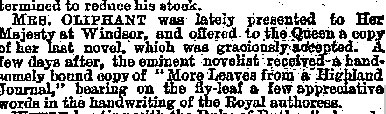
You do need a fast internet connection to use this database, which is fully searchable. You can bring up a list of articles that contain the word "orphan" for example, and then click on the one that interests you and see the image of the article itself, in a very clear scan. You can also look at whole newspapers. For example, the June 21 1851 edition of the Daily News (of London) provides an index of exhibitors at the Great Exhibition at the Crystal Palace (see the ad below). Also below, from a bit from a regular feature called "Fashionable News" on the Victorian novelist Margaret Oliphant's chat with the Queen about her latest work.

All in all, a great resource.

Mrs. Oliphant's novel

June 20, 2005

when characters take over

Here's an odd thing. Elizabeth was writing a letter, and Nathaniel just... decided it was his job, this time, to share the news. So he took over. I was thinking it would be Curiosity who took the pen and paper away from Elizabeth, but I find I was wrong.

It is definitely Nathaniel's voice, and more than that, I can feel Elizabeth's sense of pique about the whole thing. She doesn't like being coddled, you know. This is one of many ways in which she and I are nothing alike. I daydream about being coddled. Someone bringing me things I didn't even know I needed or wanted. Adjusting the shades and pillows, magically producing books I've been wanting to read. Offering to brush my hair. Shall I peel you a grape? That kind of thing. Of course I might really dislike it if I ever got what I daydream about. I probably would, because I'd be worried the whole time about what a terrible imposition I was being. It's not easy to shake off a Catholic upbringing, I tell you.

Elizabeth doesn't like the idea at all. Though she has good cause to take a rest, she bristles at the need and also at the fact that others won't let her forget the need.

June 18, 2005

speak up

To those of you who have emailed me to say that you appreciate these posts of mine on the topic of fanfic; or that you disagree with me on the very same topics, please note:

There's a link below every post. You click it, and write in what you have to say, and then it appears right here, and becomes part of a bigger discussion. I'd be more than happy to see such a discussion happen, because, please note: if I embark on six different sets of email correspondence on this topic, I'll never write another novel, and then I won't be a real writer any more. According to some people.

Cindy and Meredith and sGreer and Lisa all commented, and thy are still alive and well. You give it a try, too. Please.

lemme go

This has been bothering me ever since my last post, and so I'm going to get it down here and then, hopefully, I'll be able to move on.

So Lee Goldberg. You know the whole controversy. If you don't, and you don't care, the rest of this won't interest you. If you do, read on and read this: Smart Bitch Candy goes after Lee. (Be warned, there's a lot of talk about processed meat products.)

In the many comments to that post, Robin (not my radiant Robyn Bender, a different, but also thoughtful variety of Robinosity) says

So does that mean JM Coetzee’s Foe (starring BOTH Crusoe and Friday) is fanfic or a derivative tie-in? Maybe he should give his Nobel prize back, or better yet, use it to beat some sense into Lee Goldberg, et al.
Which made me realize what was nagging at me. Lee Goldberg tells us it's wrong to use somebody else's characters without express permission of the original author. So was Coetzee wrong? What about Tom Stoppard (Rosencranz and Guildenstern are Dead)? What about the dozens of authors who have written books about Sherlock Holmes?

I anticipate that Lee will say that these cases are different, because the author has been dead for a long time. My guess is that in his view, it's okay to drag the characters of dead authors out to play. And it's even okay to publish a novel and make money off of them. So my question: Does that smack of necrophilia, or grave robbing, or some odd combination of both? Curious minds want to know.

Also, I just realized that there's some logical fallacy in Lee's whole argument which is right on the verge of revealing itself to me, as in a vision, with singing angels and glowing stars and all that goods stuff. If the vision comes to you first, please, post it, and save me the excitement.

June 16, 2005

tie me up, tie me down

Lee Goldberg doesn't like fanfic. A few observations: (1) Lee's entitled to dislike fanfic (just as I am entitled to like it); (2) he is getting a lot of attention not so much for professing his dislike, but for arguing that fanfic is wrong:

I would never write a book using someone else's characters unless I was hired to do so. It would never even occur to me because the characters aren't mine.

(3) Lee himself writes novelizations or tie-ins, where a television show is turned into a novel after the fact. He summarizes his position on the difference between fanfic and tie-ins here.

Then there's Naomi Novik (who has a forthcoming historical novel, the first in a series called Temeraire). Naomi likes fanfic (thanks to Rydra Wong for the link), and she has made a point that for me, summarizes it all:

I for one would be thrilled to know that people loved my characters and my world enough to want to come on in and play, not to mention that I would be wildly grateful for the free publicity. I would love for people to put up posters and make costumes and invent their own stories and fantasize about my characters. If they did, that would mean I was doing something fundamentally right -- that I was creating characters that people wanted to make part of the shared culture by which we communicate with one another. And if enough people feel that way about my characters, I am going to get to keep doing this work that I love.

I would add to Naomi's point the following: if you are a good storyteller, and you create a world with real characters in it, those characters can't stay within your control. It's just not possible. You can try to legislate their whereabouts, but Romeo won't be tied down, nor will Elizabeth Bennett or Seven of Nine or John Crichton. Once a good character has been set free in the minds and imaginations of your readers, that's it.

Can you stop somebody writing a novel about a character you've created and making money off of it? I could, if the occasion arose, but I doubt it will. Because this isn't about money. It's about the story. So I'm with Naomi. If readers want to play with the characters I put out in the world, I am gratified to have done my work so well.

June 14, 2005

words

Once in a while a word gets stuck in my teeth and I have to find a way to dislodge it. Today I had two such words.

The first is stoop. Such as, I remember sitting on the stoop with my grandmother when she came to visit. Or: The front stoop was where we spent all our time on summer evenings.

What an odd, odd word, no? But the OED tells me that it has been in use in this way since at least 1789:

a. ‘An uncovered platform before the entrance of a house, raised, and approached by means of steps. ... 1789 Massachusetts Spy 20 Aug. 3/2 Several persons were in a stoop and at windows within fifteen or twenty feet from the tree. 1833 C. P. TRAILL Backwoods of Canada ix. (1836) 142 The Canadians call these verandahs ‘stoups’. 1837 HAWTHORNE Amer. Note-bks. 13 July (1883) 58 Councillors seated about, sitting on benches near the bar, or on the stoop along the front of the house. 1856 MISS WARNER Hills Shatemuc ii, He was cleaning the harness of the wagon, and he took it out into the broad stoop outside of the kitchen door. 1883 STEVENSON Across the Plains (1896) 16 The clear, bright, gardened townships spoke of country fare and pleasant summer evenings on the stoop.
The other word is from the poem I quoted in a post a few days ago, to wit:
I say that words are men and when we spell
In alphabets we deal with living things;
With feet and thighs and breasts, fierce heads, strong wings;
Material Powers, great Bridals, Heaven and Hell.
Aren't you wondering what a great Bridal could be? Here, the OED explains it:
1. A wedding feast or festival; a wedding.
 (The sense ‘wedding feast’ is distinct in early usage; by the time of Wyclif the word was often extended to include the whole proceedings of the wedding or marriage, in which use it was often made plural (cf. L. nuptiæ, sponsalia, F. noces, ME. sposailes, mod. nuptials); it is now chiefly poetic, except when used attributively (see 2).
And while I was sloshing around in the OED I decided to look up one of my least favorite words. To my surprise, I found that people have been using this word in the same way for a long time:
Hubby. A familiar colloquialism for HUSBAND.


 1688 E. RAVENSCROFT London Cuckolds 28 Oh my hubby, dear, dear, dear hubby. 1798 MORTON Secr. worth knowing Epil. (Farmer), The wife, poor thing..Scarce knows again her lover in her hubby. 1803 True Briton in Spirit Pub. Jrnls. (1804) VII. 274 My dear Hubbey, this can't make me sick. 1887 Pall Mall G. 23 July 11 In disputes between a hubby and his better half.


I provide these quotes in the hope that they will curl your toes, and convince you never to use the H word, if indeed you have been committing that particular infelicitude. And before you ask: no. Infelicitude is not in the OED, but I'll remind you that human language is a flexible construct, ever renewing itself. It is within my power (and yours too) to coin new words by taking liberties with bound prefixes and unbound suffixes and even (gasp) infixes, jumbling all or some of these up with whatever roots strike my fancy.

quick! quick!

Have to get writing, but a few things:

To those of you who emailed me or otherwise expressed concern, the pruned finger is all better. Don't worry, please. The post was just my way of dealing with the bigger problem: my accute needle phobia, which engulfs me whenever the idea of going to the doctor or the hospital comes up.

Wendy Duran has some interesting news about a new website where she and Helen Kay will be reviewing romance novels. What has been missing, up til now, is thoughtful discussion of the genre. Talk about characterization and theme and prose and plot. This newest venture gives me hope that (eventually) we might be able to get people past the knee-jerk reaction to the very idea of romance fiction (I-don't-read-romance-I-read-real-books).

I'm in love with Post Secret, where people mail postcards expressing fears or secrets. The images and words and the overall effect... mezmerizing.

*the other site I visit regularly for commentary on romance writing is the work of the Smart Bitches (all of the romance, none of the bullshit).
-------
this post was edited to make it at least partially coherant.

June 12, 2005

advances in medicine

So what happens when you are in a hurry and you neglect to properly close your very, very sharp Felco pruners and then, in a fit of whimsy, tuck a fourteen pound dog under one arm while you're carrying the pruners, a half dozen freshly cut flowers, and an empty yoghurt container in the other hand?

Yes, that is what happens. The pruners decide to go to work on your flesh. You drop the dog and everything else while blood spurts.

It really wasn't as bad as it looked at first glance. Fingers bleed a lot. Lots of blood vessels. Those big drops of blood that led from the front garden into the kitchen? Nothing to worry about. Three hours later, looking into a trash can filled with bloody paper towels? Still no need to go overboard. People are way too read to rush off to the emergency room these days. My father, who cut himself on knives in the restaurant kitchen on a regular basis, would scoff. Scoff, I say, at the paltry nature of this ... minor inconvenience.

And see, it did stop bleeding. Finally, it stopped bleeding, and when I got up in the middle of the night there was no lake of blood. No soaked sheets. A bandaid doesn't hold very much blood, you know. It's no big deal to have to change a bandaid.

Fast forward to a conversation with my doctor, who I happen to like a lot. We talk about books and kids and all kinds of stuff. It's perfectly natural for me to stick my finger in her face and say, hey! Would a butterfly bandage work on this? And, do you happen to have one lying around?

Images Did she get upset? No. She looked at my finger calmly. She turned on another light to look at it some more. Did she yell at me about going to the emergency room? Speak of dire consequences, blood poisoning, necrotizing fasciitis? No. She whipped a tiny tube of Super Glue out of her pocket, grabbed my finger, and glued it shut.

Okay, so first she asked me how I had cleaned it out. But even as she was asking, the tiny glistening drop of Super Glue was hanging over my rent flesh.

And it worked. I can type, I can cook, I can do anything I need to do. No blood, no pain. In fact, it took google less than a second to assure me that it wasn't only my good doctor who is using Super Glue to close wounds. Apparently (hold on tight, girls) midwives are using it to close tears in the perineum.

Someplace, somehow, I've got to fit this into a storyline.

June 11, 2005

the coin that sings

Booksquare as a quote on writing that I'm going to have to memorize.

The paradox of writing fiction is that, at least for the author, it is reality. My characters are trapped in a situation that’s achingly plausible; I’ve got to help them through it to a credible resolution. This feels like decent, blue-collar work. And it has the small satisfaction of human-scale protest. A novel is a story, and stories have a kind of primitive power—they’re the weeds that grow in the sidewalk cracks, the campfire fables and telephone tales that can never be stamped out.
This reminds me of a poem I adore:

I say that words are men and when we spell
In alphabets we deal with living things;
With feet and thighs and breasts, fierce heads, strong wings;
Material Powers, great Bridals, Heaven and Hell.
There is a menace in the tales we tell.
From out the throne from which all language springs
Voices proceed and fires and thunderings.
Oh when we speak, Great God, let us speak well.
Beware of shapes, beware of letterings,
For in them lies such magic as alters dream,
Shakes cities down and moves the inward scheme.
Beware the magic of the coin that sings.
These coins are graved with supernatural powers
And magic wills that are more strong than ours.

Sonnets from a Lock Box

Anna Hempstead Branch, 1929

too much of a good thing. and then, not enough.

Before I report on my word count (and let me say first, it's not what I hoped for), a request.

I was asked to come up with a list of historical novels that would lend themselves to being discussed by a bookclub. All women, all very smart and discerning. So I sat down and thought and thought and put titles on the list and took them off. My criteria: a novel that worked for me personally (it's my list, okay?), a variety of settings and subjects, voices/approaches, and my sense that there's a lot to talk about. And now I have fourteen titles, where I'm only supposed to have ten. I'm sure that I'll think of another ten that should be on the list, but really what I have to do right now is take off four.

So, what do you think of this list? What should go, and why? Personal preferences are perfectly fine, but please do tell me what it is that makes you turn away from a particular title -- whether you've read it or not.

The list is in alphabetic order, so I don't give away my own leanings.

  • A Soldier of the Great War - Helprin (Italy, WWI)
  • Aztec - Jennings (Mexico, Invasion/Conquest)
  • Cuba Libre - Leonard (Cuba, Spanish-American war)
  • Hearts and Bones - Lawrence (Maine, 1789)
  • Julian - Vidal (Rome, 4th century)
  • Lonesome Dove - McMurtry (the west, late 1800s)
  • Niccolo Rising - Dunnett (Bruges, 15th century)
  • Sacred Hunger - Unsworth (the Middle Passage, 17th century)
  • The Dress Lodger - Holman (Victorian London)
  • The English Patient - Ondaatje (northern Africa, Italy, WWII)
  • The French Lieutenant's Woman - Fowles (Victorian England)
  • The Physician - Gordon (London, Europe, Persia, 11th century)
  • Thread of Grace - Russell (northern Italy, WWII)
  • White Doves at Morning - Burke (Louisiana, Civil War)

I know what you're going to say. No Asia. I can't come up with anything I like enough to put on this list, but I'm sure I'm forgetting many titles. And if you're wondering why Byatt's Possession isn't on the list, I think it may just be too much for a bookclub to bite off.

Okay, so I'm still short 2,000 words this week -- but I've got until tomorrow evening. Never mind that I have to make crab cakes from scratch for twelve good, dear friends, all of whom will descend on us tomorrow evening at six. Never mind the weeding, the ironing, the quilt I'm desperately trying to piece, the fact that the girlchld has to be driven hither and yon, and the puppy boys who need my attention. 2,000 words, by tomorrow evening.

June 10, 2005

if time were endlessly flexible

and money were never an issue, I would be busy but not anxious. If I could spend my time as if nobody depended on me, and I depended only on myself for direction I would write when the story moves me, and otherwise leave it to cure. Like good cheese, or wine.

I would work on the dozen or so fiberart projects I've been thinking about for months. I'd start a new one whenever the inspiration came to me.

Lastlaughstamp I would play with colors and images and paper and photos and send correspondence art to everybody. You too.

I'd take a dozen workshops every year, starting with the five day intensive drawing on the right side of the brain. I'd drive across country if necessary, and take the dogs with me and whoever else wanted to come.

I'd study ASL and Italian until I was fluent in both.

I'd sleep late or get up early, depending on the weather and whether or not I had a good book to read.

I'd start a dozen different small businesses that interest me and then find good people to run them. I'd start an arts center and stay involved in that myself.

I'd have six Havanese, and a double-king size bed so we could all sleep together without forcing my husband to sleep on the floor.

I'd quilt, and draw, and garden, and paint, and take my daughter to Manhattan and Chicago and San Francisco and Vienna and Munich.

I'd visit my friends and once a year I'd rent a huge house on a perfect beach and invite them all to come and stay. For that month I would do nothing, not write or read, nothing but sitting on the porch and talking with those friends. Sometimes we'd go for icecream.

For the good life I do have, I am thankful. Now I'm going to write.

June 7, 2005

Jim Fusilli

I ran into a cover that really caught my eye. Here it is, Jim Fusilli's Hard, Hard City. So I'm looking at this book, reading the jacket copy, and wondering how I have missed this author and this series, because it's got three things that I really like: a thoughtful, troubled, not always likeable main character (Terry Orr, an author turned private investigator); it's set in modern day Manhattan -- and not an idealized Manhattan, either; and there's an extended cast of wonderful, very vivid characters.

Hard, Hard City is already the fourth book in this series, so I forced myself to go back and start with the first one. I've now read Closing Time and A Well-Known Secret, and as soon as I can get hold of Tribeca Blues and Hard, Hard City, I'll read those.

Fusilli is a journalist, and he has an excellent website with lots of interesting essays. The essay "Why I stopped reviewing crime fiction" originally appeared in the Wall Street Journal. It gave me a lot to think about.

And yet: here I am, reviewing Fusilli's work. Because really, when I run into well written fiction, I need to record my thoughts. Maybe you need something new to read, maybe not. In any case, I would recommend these novels, which may not be flawless, but which are pretty damn good all the way around.

We meet Terry Orr at a bad time in his life. He had been a successful author, blissfully married with a young daughter and a two-year old son, when a madman shoves the baby's stroller off a subway platform into the path of an express train. Terry's wife Marina, an accomplished artist, goes after the boy to try to save him, and they both die. Terry is left with his ten year old daughter, Bella, some close friends, and a need for revenge that charges right over the line into obsession, and without apology.

These are crime novels with plots. Terry gets involved in the lives of people around him. When there is a crime that touches him, he takes it on, and pursues it. The violent act that changed his own life is a constant backdrop in the first two novels, but it's not really integrated into the plots themselves.

Fusilli took on quite a challenge, approaching things this way. We've got the larger story: a character study of a man in terrible pain, struggling to make sense of things, to keep moving forward; he's got a young daughter who needs him, after all. (And Bella is, without a doubt, my favorite character in these novels. I like her much more than I like her father.) Superimposed on that we get the individual crime plots in each of the books. Both elements are crucial, but Fusilli balances them far better in the second novel than he does in the first.

I liked the first novel -- Closing Time -- for its descriptions of Manhattan, and for the characterizations of the people closest to Terry. They were vivid and believable, touching and irritating, intriguing in many different ways. In contrast, the characters who were part of the murder investigation were flatter and felt -- I suppose the only word that really works -- unpolished. Not badly written, not at all: just distinctly less interesting than the main characters.

But the second novel. The Well-Known Secret gives me the sense of Fusilli as an author who has become comfortable with what he's trying to do. He branches out a little in his approach in ways that really work for me. The novel starts with a newspaper article, an interest piece written about Terry, his background his losses, his daughter, his new work. I love bringing different kinds of texts into novels, and this is an excellent example of how to do that. It provides the backstory in an intriguing, clean, detached way, something Terry himself could not do as a first person narrator.

More than that, this novel is set post 9/11 in the very neighborhood that was most devastated by the loss of the Twin Towers. Terry's daughter goes to a school where more than half the kids in her class have lost at least one parent in the attack; they were unable to enter their home for a month, and had to live in a hotel. I got a real sense of what it was like to survive 9/11 in TriBeCa, and to go on surviving it, but without even a touch of pathos. Here and there Terry provides details of what those days were like, simply, powerfully. This novel is worth reading for that aspect alone.

The bad news is, I don't like Terry much. He is a man in pain, yes. He has suffered terribly, but he also wallows. I wanted to smack him by the end of this novel. So did a few of his fellow characters. This was only partly ameliorated by the absolutely perfect tone and pacing of the final chapter, where Terry goes with Bella to the subway station where Marina and Davy were so violently murdered, for the first time. I won't say anything more about this chapter other than this: it deserves to be read.

I am sorry I was unaware of Jim Fusilli's work for so long. I'm hoping there will be many more novels to come.
June 6, 2005

catching up

Given the fact that I lost almost three days to a virus, I did okay in the last week in terms of word count. A total of 6,280 words, which is only 800 shy of where I wanted to be. This week I'll try to catch up.

Right now I am writing a sex scene. I haven't written a full blown, extended, explicit sex scene in a while, so I'm feeling my way moving forward carefully. The two people in question are a little angry at each other, which provides an interesting edge. One of them has turned out to be much more ... forceful than I had imagined. Once a character strips down and gets busy, I learn a lot about them. It's a little disconcerting, actually. I feel like a voyeur, which doesn't really interest me otherwise. She said firmly.

A note: a very kind and loyal reader in Scotland wrote to me recently:

I just wanted to mention I have a started a Into the Wilderness group through Yahoo! and wondered if you could let your fans know. I would love to be able to talk about your books with other people who love the books as much as I. I had noticed you didn't have your discussion page on your website so I decided to add a group!

Shona didn't actually give me the url of the Yahoo group. So: Shona, could you please post that here, or email it to me?

Those readers who have been around for a while will note that this idea has come full circle. The first Wilderness discussion board was on Yahoo, and a very good group it was, too. I hope Shona will be able to get something going.

June 5, 2005

note from an imaginary home

Please excuse s/r's three day failure to report to her weblog for duty. She had a fever and a headache, and generally was feeling under the weather.

She has every hope of returning to her work tomorrow.

Austen Jane-2

June 2, 2005

the x in xlibris

First, yesterday: 1,250 words. Normally I round off to the nearest hundred, but this time every word cost me dearly.

On another front: the Smart Bitches, dog bless them one and all, have really dug in on shutting down the ebook thievery at Bookaza. Follow the comments to get the whole hair-raising story.

Today I've been busy laying out the June issue of The Magazine at Gardensense Online, but never fear. Those words will get written anyway, if I have to stay up til midnight to do it.

And here's something odd. Maybe something that should irritate me, but I don't have the energy. I got an email this morning with the subject line: Make your dreams come true!!! Publish your own book!!!
(Do note: SIX exclamation points. Six.)

Exlibris

Dear Ms. Sara Donati, Hi, my name is Jackie Flores and I am from Xlibris Corporation, a publishing company affiliated with Random House, LLC. Here is some information about our company and the services we are currently offering. Xlibris is a print-on-demand publishing service provider. It means that we can publish a book in as little as one (copy) to as many as a thousand, depending on you -the author. We offer two basic publishing services: the Trade Paperback Service - for manuscripts of text, and the Picture Book Service.

First, you should notice that this particular vanity publishing outfit takes pains to point out its relationship to Random House.

Second, in case you didn't realize: I have four novels in print with Bantam Books, which is in fact a part of the Random House group. So now I'm wondering if other Random House authors also got this great offer. Maybe Janet Evanovich, Lee Child, Dean Koontz, Ha Jin, Kazuo Ishiguro and Charlie Baxter got their own personalized notes from Jackie Flores.

I can't decide whether I should forward this to my editor at Bantam, or not.