" /> storytelling: May 2005 Archives

take me to the front page of the tttt weblog | back to the current weblog

« April 2005 | Main | June 2005 »

May 31, 2005

evil in a cup

Chantico Cynthia wants to know why I call Chantico (something you can order at Starbucks if you don't drink coffee) evil in a cup.

The answer: take cocoa butter and whole milk and steam it, resulting in something that tastes like a melted truffle. Six ounces (a tiny cup) = 390 calories, 21 grams of fat and 51 carbs.

progress, thievery, and ranch dressing on the side

Today's word count: 1,200.

To reward myself for continuing productivity, I'm going to make a list of words I don't like. No explanations; I just don't like these words and thus it's a safe bet to say you won't find them among the 1,200 I put down on paper today:

hubby
canker (as in 'canker sore')
maroon
utilize
lozenge

Also: Disturbing alert from Candy at Smart Bitches and also from Booksquare: there's a website called Bookaza (no link for them, no sirree) which calls itself an ebook retailer, but looks to be a pirate's den.

Pirate: Somebody who sells books or ebooks or other intellectual property without entering into a formal arrangement with the publisher, for which the publisher and author are not paid.

Two of my novels are being sold at Bookaza. And, to add insult to injury, they give those two novels a lousy three stars out of five. How very rude. If you're going to rob me, you could at least smile while you do it.

Finally, another disturbing bit, this one by way of the radiant Robyn Bender and her partners in crime, Cassandra and Rydra Wong. William Shatner, who will forever be Captain Kirk in the minds of the StarTrek fen, is now playing a lawyer on the television show Boston Legal. And so what, you ask. Well, this is what: he recently filmed a scene with James Spader, who also plays a lawyer. A sex scene; both the characters are gay. Do I care who William Shatner or Captain Kirk or Bozo the Clown sleeps with? No. I do not. Consenting adults, and all that. Is it possible that this is a beautifully done, well written scene? Well, sure. Anything is possible, but I do have my doubts, I must admit. Those doubts were intensified by this excerpt from an interview with the two actors concerning this particular scene, where Spader describes Shatner's body aroma like this:

"He had a very sort of, a strangely very attractive sort of pungent sort of gamey, sort of a venison or a lamb sausage... and a little bit of rosemary with a touch of ranch dressing."

For the whole horrifying interview, click here.

May 30, 2005

Misdemeanor Man - Dylan Schaffer (3 out of 5 stars)

At one point I thought I wouldn't finish this novel, because things about the story irritated me. But in the end I found that the characters were interesting enough to keep me coming back.

Schaffer's characters are an odd lot. I usually like odd, and I have no objection to a good dose of humor in my suspense/crime novels. In this case I'm not sure that the oddness always works. The main character is Gordon Seegerman, a public defender and a rather sad sack. Gordon is happy to be relegated to defend misdemeanor types because that is easy to do and doesn't demand too much of his energy or time. His real love is as the lead singer of a Barry Manilow cover band, Barry X and the Mandys.

Have I lost you? I wouldn't be surprised. I think I was able to finally accept this premise and move ahead because Gordon is actually likeable, and he's got some tough stuff to deal with. He's also a better guy than he intends to be, and that's compelling.

There's a complex set of mysteries here that start when a reformed alcoholic who works as an accountant for a big-name charitable organization is arrested for flashing a young girl. That misdemeanor then spirals out of control into something very different, and bodies begin to appear. Gordon gets pulled out of his sedate approach to his career and sucked into the big time.

The best I can say about this is that it makes me interested in reading more of Schaffer. I'm glad I stuck it out with Gordon, but my opinion about Barry Manilow hasn't changed, not one iota.

Oh and by the way: great cover art.

progress

On Saturday I wrote 1,100 words. That was a good day. Then I spent lots of money on fabric, so you know: demerits for that.

On Sunday we had the usual suspects over for dinner to celebrate my daughter's birthday. Yes, that was three weeks ago. So we're disorganized. More demerits. However, the food turned out great and eleven people had a grand time. By this point I'm hoping you'll notice that the word count for this day was, um, nothing like yesterday's. In fact, it was nothing.

However. Today I ignored the mess in the kitchen, the dining room and on the deck. I ignored the fact that my desk is piled high with papers and somewhere in that mess are a few bills I have misplaced. I ignored everything and I went to Starbucks and wrote 1,300 words. And I spent no money on fabric today. I did, however, spend money on bedding plants, though nothing outrageous. So today was all plus points, unless you count the mess in the kitchen. Which I do not. Also, I spent four hours at Starbucks writing and I did not cave in and order a Chantico, which is evil in a cup.

The total for this three day weekend: 2,400 words (which is just over ten manuscript pages, courier new, 12 point, double spaced), a handful of demerits, and a messy kitchen that still refuses to straighten itself out.

Now I'm going to eat leftovers and go watch television until I can ignore the kitchen no longer.

May 28, 2005

something not-so-bad. she said guardedly.

Cornuto On the basis of my observation of the circle of writers I personally know pretty well, I will venture a generalization: we're a superstitious lot. The reason, I think, is because the writing process is often so opaque. Opaque is hard for people who like to have control over their lives. In my case, add to this the fact that I was raised by a father who grew up in rural Italy, where superstition is an art.

Italian Americans call it maluch, which is southern dialect for malocchio, or bad eye. The evil eye. I'm tempting fate by writing about this, you see. Thus the cornuto, because here goes anyway.

Today I forced myself to go through the entire Queen of Swords manuscript and make a list of every scene. I did this by setting up a style which I formatted in a small font, bright red, justified right. I made a short title for a scene that covered the basics, and applied the style. Like this:

POV Hannah: Rattling Gourd and his view of the world
Hannah.... ....... ....... ........ .... ......... ..... ... ....(scene goes on for 1.5 pages)
POV Jennet: street vendors, dealing with Rachel, and her own memories.
In the evening Rachel sought out Jennet (scene goes on for 2 pages)... .... ........ ........

Because I included an outline level in the formatting of the style, I can now switch to outline mode and see only the list of scenes. I then went though my chronology (which is crucial when writing a big, involved book like this with a lot of backstory and metastory) and put in dates so I could see how the narrative moved (or stalled) over time.

And a few things jumped out at me right away. Missing scenes (some of them quite interesting to write); missing POVs. A plot twist that was kinda sitting there without development. A character who was trying to get my attention. And best of all: where it was that my characters were going to run into Andrew Jackson, the why and how of it. That was something that had been worrying me. I have a very clear picture of Jackson on the December morning he came to New Orleans by way of the Bayou St. John, the men around him, the place he stopped for breakfast, and where he went when he got to the city. What I wasn't sure was, if I could convince any of my people that they needed to interact with him. Hannah detests the man, and Luke doesn't much like him either. The other characters are wound up in their own problems.

However, the answer was sitting right in front of me. Once I stood back and took stock of the whole situation, it all fell into place.

I made a list of about twelve scenes to write straight away. Four to be inserted in earlier parts of the story, and the rest following from where I stopped today.

May 27, 2005

don't know how I missed this one

I've read only one of M.J. Rose's novels, Lip Service. I liked quite a few things about it but for one reason or another, didn't review it. I am looking forward to The Halo Effect , which is near the top of my TBR stack. This is one in a series of novels about a psychiatrist at The Butterfield Institute, a Manhattan sex therapy clinic. Not your run of the mill suspense setting.

It turns out M.J. Rose has got a hugely useful, interesting complex of websites and weblogs. Buzz, Balls & Hype kept me happily procrastinating this morning for longer than I will admit. The woman seems to have endless energy. She's got a ton of good ideas about marketing for novelists and about the writing process, too. And she's got a cute dog. What's not to like?

Now I have to go really push to reach my week's goal. Wish me luck.

May 25, 2005

crickey.

Galley Cat (a favorite site of mine, by the way) has posted links to the sources of hard numbers on the number of books published and thoughts thereon. Also, some good graphics.

why I appreciate my agent

Sarah at Confessions of an Idiosyncratic Mind has a piece today about Todd Goldberg, whose agent is sending a new book out to various editors. Todd is anxious; of course.

Sarah sez:

It is amazing how we torture ourselves in new and exciting ways, each and every time. But that said, I get the impression that when submissions go out, the agent has more say than the author as to who it gets sent to. Is that really the case (and if it is, that's obviously not necessarily a bad thing), and if so, why wouldn't writers have more input into who they believe is the right editor for their work, especially if they are market-savvy and pay too much attention to industry gossip?

I recently went through this process with Jill, my agent (about which there will be an announcement in the next few weeks). When she was getting the package together to send out, we talked on the phone a lot. As Jill was putting names on the list of editors she would tell me about her reasoning, ala:

X at (Publishing House) is somebody who I respect because s/he (good thing). Also, s/he bought (title of novel), and when I had lunch with him/her last month, s/he raised your name. I think there's some potential real interest there.

Jill always asks me: are you familiar with the editor? Do you know anybody who works with him/her? And the reason she's asking this is because it makes sense. What if I went to high school with Editor X and we were sworn enemies? What if Editor X did something less than nice to a close author friend of mine? What if I adore Editor X above all others?

I have never been in the position where I had to ask my agent to take a name off the list. This is her area of expertise. She spends a good hunk of her time talking to editors to find out what they're thinking and what they want. This is something she does for me that I can't do for myself. It's how she earns her living.

On the other hand, I can raise names. I can say: I really like Author X's books, and I think they're edited by Editor Y at (Publisher). Might that be a good person to have on the list?

And we'll talk about it.

I'm unsure if other authors have this same kind of relationship with their agents. I wonder sometimes if I've just got an especially good thing going. Because, you know: I could make a much longer list of things I like about Jill. Who is my second agent; I could make an ever longer list of things I did not like about her precedessor.

email

I believe (I hope) I've solved the email problem, or at least, I'm on my way to solving it. See the right hand column.

Let me say here once again that I have a big backlog in email. I read everything that comes in, and send silent thanks. Then I try to get back to writing.

May 23, 2005

teacup, tempest. or not.

To this point I have avoided writing about the newest loud discussion over at the Litblog Co-op, but I find I have weakened in my resolve to keep my questions to myself. I made this resolution because I had my own run in with the Litbloggers, which began here, migrated over there (note how in the last comment to the nudge nudge post genevieve, especially, scolds me with raised finger*), moved back here, and then ran out of steam. Which was fine, though the last exchange was left hanging in midair with a question unanswered.

The newest bruhaha has nothing to do with me, to make that clear right away.

Here's the controversy: the LBC folks got together and picked a novel that they recommend that everybody read. Their mission (in their words):

Uniting the leading literary weblogs for the purpose of drawing attention to the best of contemporary fiction, authors and presses that are struggling to be noticed in a flooded marketplace.

The first book to be recommended is Kate Atkinson's Case Histories. I haven't read this novel, know nothing about it, have no opinion on whether or not it was a good choice. Lots of other people do have an opinion, though. There was a very vocal minority which found the selection of this book to be outside of the LBC's stated purpose (promoting authors struggling to be noticed) because Case Histories did get quite a lot of press and Kate Atkinson is not a new name in literary circles. (See Paperback Writer on this topic, here.)

I do have a point. Here it comes.

In the back and forth on this topic, there was some discussion of what it means to be 'struggling' and 'unknown'. Some claimed that Kate Atchinson does fit this bill; others claimed she does not. Some folks did a quick and dirty survey where they asked people at Starbucks if they recognized the name. (Coffee drinkers did not, apparently.) Others said this was not a good indication of how struggling an author was.

Here's the thing. I think we tend to get so caught up in our squabbles and discussions that we forget what a teeny tiny part of the universe we occupy. Most people won't know who Kate Atchinson is. They also won't recognize names like John Updike, Alice Munro, Toni Morrison. This is my theory, but I'm going to test it in a slightly less adhoc way.

I'm going to put together a list of ten names. Half of them will be author's names, including Kate Atchinson. Some of those will be big hitters like Updike. I won't use any ringers (no Stephen King or JK Rowling). Everybody will be living. The other names will be made up, and I'll check to make sure that they aren't authors I haven't heard of. Then I'm going to recruit between five and ten kids from my daughter's high school, and I'm going to ask them to go out into public places and ask people they don't know about the list of names.

And then I'll get back to you. Before I get started I'll post my list of names, in case you want to play along. Oh and: if it turns out I'm wrong, I'll be clear on that. If I'm right and the names on the list draw a general blank, I will have no sweeping pronouncements to make on that count. I'm just interested in how isolated we writers really are from the rest of the world.

EDITED TO ADD: the actual list. Here are the ten names:

1. Chris Clarke
2. James Robinson
3. Margaret Atwood
4. Erik White
5. Sue Kidd
6. Michael Chabon
7. David Gardener
8. Philip Roth
9. Kate Atkinson
10. Joanne Mitchell

You can download the Word document with instructions for the people who will be conducting the survey by clicking here.

*Genevieve also calls my original post sullen and morose. And I was trying so hard to be Nice.

a new feature: covers I like

You'll have noticed, if you visit here now and then, that I obsess about dust jacket/cover art and design. I am very visually oriented. That's part of my excuse, if I need one.

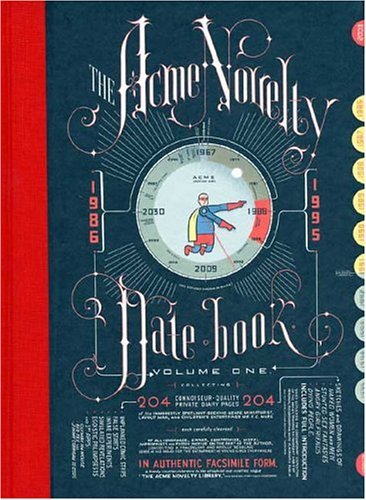
At Swim Two Boys In the bookstore, when I come across a jacket I love, I have this almost undeniable urge to grab people and show it to them. Which mostly I can resist, unless there's somebody near by who knows me well enough not to get alarmed. And then today it occured to me that I can show these covers to you. Which I will, every once in a while. Here are two, to start with.

The first one is built around a photograph. I'm an easy sell when it comes to this kind of image. I love the motion and movement and energy in this picture. It makes me want to read the book. Which I haven't, yet.

The Acme Novelty Datebook was designed by Chip Ware, who does great work but is not to be confused with Chip Kidd.

Chip Kidd may be the leading book designer in the world. I first took real note of his work on some of Ann Rice's novels, then the cover art for Dennis Lehane's Shutter Island really caught my attention. He does some very quirky, interesting stuff, as is the case here.

If you've got an example of cover art you really like, do let me know. I'll go have a look.

fictionblogs: I should have realized.

For a while now I've been taking dictation from one of my major characters. Never mind which one. This person talks in a diary-type voice, and I write it down. I have been doing this in a plain old word processing document. Silly me.

It seems that lots of people have been busy using weblogs to write this kind of fiction. There's a list of them at Fictionblogs. A random example: Ravenstone Tower.

After the death of his mother, and some time spent in care, young Jamie Robson was sent to live with his grandfather (The Captain) in an old tower in the wild country near the borders of Scotland. Read the journal of his new life and adventures. Trouble? Jamie? Nah...

I haven't read Ravenstone Tower or any other fictionblogs, and I probably won't. There are enough distractions in my life. However, I'm thinking that this chatty character of mine might like a weblog of her/his own. Which will remain solely between the character and me, probably forever. It's a promising idea on how to get into this (or any other) character's mind. Also, it would be possible to incorporate drawings or whatever else the character wants to include. What an excellent idea.

This link via Paperback Writer (for which many thanks).

May 22, 2005

Broken Prey - John Sandford (3.5 out of 5)

Sandford's series of novels built around the Minneapolis detective Lucas Davenport are consistently excellent reads. Seventeen novels into this series the writing is still fresh, full of energy and compelling. Lucas is older, but he's still got that cynical bad boy edge to him, and a good dose of self depreciation that makes him so likeable. On the other hand, Sandford had to domesticate Lucas, finally, and that's both good and bad. Lucas was a lot of fun when he was out there appreciating women, but I really like Weather (his wife, who is a surgeon) and the way they talk to each other.

This Prey novel is a bit of a departure in three ways:

  • Often in these books we know the bad guy right from the start, and it's just a matter of Lucas pinning things down. This time we think we know a lot of things and keep finding that we don't. Until we do, quite late in the game.
  • There's very little of Lucas's personal side. Sandford ships Weather and the rest of the household off to London for the summer. Weather's role is limited almost completely to telephone calls. Lucas misses Weather. I missed Weather. I realize Sandford was trying to simplify on one side because he had a very complex story to handle, but I didn't like the shortcut he took to do this. To offset this lack, Sandford does provide something interesting. Throughout the novel, Lucas is trying to come up with a list of the best hundred songs of the rock era. Odd conversations are tucked in here and there when friends raise the subject and suggest songs. It's quirky and works very well. Sandford went so far as to include the list at the end of the novel, which is a kind of metafiction touch that I like a lot.
  • This novel is far more procedural in approach than the others. We follow the case step by step, taking wrong turns and figuring that out, analyzing evidence, going through the mundane part of police work. My personal take is, somewhat less would have been more.

Things I liked: there are some very interesting minor characters, people we see on a regular basis, though their connection to the primary plot is unclear until very late. I found myself more interested in the story of Millie and her boyfriend than I was in Lucas and yet another dead end clue. Most of all, Sandford does a masterful job of giving us The Gods Down the Hall -- three men serving life sentences in a hospital for the criminally insane for really horrendous murders. Somehow these three seem to be directing the murders that Lucas is investigating, but how they are pulling it off, that's the question.

All in all this particular episode in Lucas's career felt a little off balance to me. It's not my least favorite of the series, but it's not in the top ten, either.

odd fact of the day

When they first developed a steamboat engine strong enough to travel up the Mississippi, it averaged a whopping three miles an hour. It was still an improvement, because up to that point, flatboats would bring merchandise and people down the Mississippi and then be broken up for the lumber.

If you're interested in odd facts, Tess Gerritson (the author of medical suspense and, at one time, romance) has a great collection of creepy biological facts.

May 20, 2005

can you name a main character...

I've seen a lot of commentary lately on the (alleged) fact that main characters (heroes, to take another approach) in romance novels are always enlightened and never racist or sexist. (Please note: I refuse to use the term PC, which has been co-opted.)

So I was thinking about this, and I tried to come up with heroes in novels other than romances who are openly racist, sexist, unenlightened. I can't think of one. Even moving away from contemporary novels, I can't. Did Jane Austen ever write a hero who spoke about the inferiority of non-white races? Did Dickens? Hemingway? Even Mark Twain's characters start out one way and end up another.

The most that can be said is that authors keep their heroes away from situations where such inclinations and beliefs would be revealed. Because if you knew that Oliver Twist wouldn't let the black footman touch him, he wouldn't be Oliver Twist anymore, right? You couldn't like him.

So if you can come up with main characters/hero types who are obviously sexist or racist, please let me know. My guess is that there may be some sexist types, but no racist ones.

editors and rejection

There's a lot of posting about rejection going on just now. An interesting piece over at Romancing the Blog, for example (don't skip the comments -- good discussion going on there). For my part, I have no real advice for people who are trying to get published and haven't found a way in yet beyond the standard: you do need an agent; to get an agent, you have to write a story.

And two observations:

1. Lots of people are very bad at self evaluation. They truly believe they are capable of a given task when in fact they lack even basic skills. Watch American Idol, and you'll see what I mean. There's some serious work in psychology which takes a less sensational path to the same conclusion.

Unskilled and Unaware of It: How Difficulties in Recognizing One's Own Incompetence Lead to Inflated Self-Assessments. An article from the Journal of Personality and Social Psychology (this is the abstract):

People tend to hold overly favorable views of their abilities in many social and intellectual domains. The authors suggest that this overestimation occurs, in part, because people who are unskilled in these domains suffer a dual burden: Not only do these people reach erroneous conclusions and make unfortunate choices, but their incompetence robs them of the metacognitive ability to realize it. Across 4 studies, the authors found that participants scoring in the bottom quartile on tests of humor, grammar, and logic grossly overestimated their test performance and ability. Although their test scores put them in the 12th percentile, they estimated themselves to be in the 62nd. Several analyses linked this miscalibration to deficits in metacognitive skill, or the capacity to distinguish accuracy from error. Paradoxically, improving the skills of participants, and thus increasing their metacognitive competence, helped them recognize the limitations of their abilities.

2. Editors make mistakes. Every editor has stories of rejecting books that went on to sell millions of copies and/or win major accolades. Some examples from Rotten Rejections by Andre Bernard:

The Diary of Anne Frank ‘The girl doesn’t, it seems to me, have a special perception or feeling which would lift that book above the “curiosity” level.’

Carrie by Stephen King 'We are not interested in science fiction which deals with negative utopias. They do not sell.'

I suspect the primary reason editors send out generic rejection letters is they don't want to be on record saying something dismissive about the next Cold Mountain or The Time Traveler's Wife.

May 18, 2005

for Jill/cover stuff


no no no

I'm often amazed at the stuff people plug into the search engine at the bottom of the right hand column, but this takes the cake:

Search: query for '"There are two types of people in the world: those who want to break in, and those who want to break out".'
To the person who did this search: You do realize that unless I wrote this sentence someplace exactly this way, punctuation, spacing and all, it's not going to show up. Right? Because that's the way it works.

PS. Great quote, by the way.

when dialogue works

This excerpt from Drowning Ruth (Christina Schwartz) is an excellent example what dialogue can do. All you really need to know before you read it is this: set on a rural farm, before the first world war; the narrator is a young woman who is looking after a mother who has been sickly for a long time. There's a younger, prettier, much loved sister called Mathilda.

Drowningruth-1I believe this is the first time Joseph is mentioned in the novel, and still: you know pretty much everything there is to know. Not about the relationship between Joseph and the narrator, but about the relationship between the narrator and her mother.

The masterful touch here is the narrator's lack of verbal response to her mother's cruelty, her turning away to look outside. That tells us she is not surprised by her mother's assessment, or capable of showing anger. So you've got to wonder at somebody who is so good at sublimating. Where does all the anger go, and what happens when there's too much of it? That's what this novel is about, for the most part.

May 16, 2005

dialogue, discourse & subtext. oh my.

I wanted to say, first off, that dialogue is one of the biggest challenges for a writer, but then I realized how empty a statement that really is. When you're sitting in front of a blank page, everything is a big challenge.

It's been established before (here, and everyplace else people write about writing) that dialogue has to do more than one thing to earn its place on the page and in the scene. Dialogue can contribute a lot to characterization, if it's handled right.

The sociolinguistic rules for conversation are complex to the extreme (there's a whole wide field called discourse analysis, and within that, conversational analysis and politeness theory). I have found that now and then, when I'm having trouble hearing characters talk to each other, it helps me if I step back and analyze what's going on between them in this light.

Various linguists have worked out theories of how power and social structure work through language and conversation. The basics (and I mean, really diluted) of this approach are:

The concept of face refers to the respect that an individual claims for him or herself, and the effort that goes into maintaining self esteem and respect in situations public or private. There are two sides to this: the need to be respected and desired, and the need not to be imposed upon by others.

Politeness is seen as one strategy in saving face for the self and others by avoiding Face Threatening Acts (FTA's). FTAs infringe on the hearers' needs for respect, desirability, and a suitable amount of emotional and physical space.

Whenever two people meet and interact, hundreds of quick decisions are made at the subconscious level. Think of being in a car with somebody you don't know very well for a long drive. You're hungry.

Strategy One: Direct On Record

I want to stop at the very next restaurant.

(no attempt to acknowledge a hearer’s Face needs: I don't care if you're offended; I'm never going to see you again, and I'm really hungry.)

Strategy Two: Negative Politeness

Did Mrs. Malone forget to mention to you that I've been traveling since five this morning?

(shift responsibility for handling a difficult interaction; higher FTA possibility:
Boy, are you dense and insensitive, you should notice that I'm in a bad way over here.)

Strategy Three: Positive Politeness

You've been driving for a long time, you've got to be dehydrated, no?

(minimize distance by expressing friendliness and solid interest in the hearer's need to be respected; low FTA possibility: Come on, guy, let's do us both a favor and take a break.)

Strategy Four: Off-Record-indirect

Gosh, look at that, one of those Amish all-you-can-eat buffets, I've heard about those.

(removing all possibility of FTA, short of not speaking at all: ... and I hope you have too, but okay, if you haven't, I'll sit here and be hungry.)

I think about these strategies when I've got characters I am still getting to know who come face to face. For example: A man is trying to connect to a woman he's just met. Of course the greater context is relevant, but I'm leaving that out for the sake of simplicity.

"So, can I have your number?" (Strategy 1)

"Your sister had the idea that you might want to go to the opera, so you know, if she had that right and you are interested I've got an extra ticket for Friday." (Strategy 2)

"You must be tired, it's really late. Do you need a ride?" (Strategy 3)

"I'd go to that company dinner, but I hate walking in there alone." (Strategy 4)

You get a sense of the personality behind each of these statements, and a place to start. The question is, how will the other person react? What happens when a Strategy 1 statement is made to a strong, self confident woman who is not impressed, or one who is very, very impressed? Or maybe the woman is distracted and bored and just not very interested herself. What strategy is likely there?

I'm playing with the Strategy 1 line above.

"So, can I have your number?"

Subtext: I like your looks and what little I know of you enough that I'm willing to (a) take a run at this and (b) risk rejection doing so. But I'm not so nuts as to give you a lot of power over me, so I'm just going to put it out there, and see how you handle it.

He gets this answer from his female counterpart:

"I'm listed. If you can remember my name tomorrow, you can look me up."

Subtext: I have evaluated you as a potential partner for sex and/or friendship and/or a more serious relationship and I find you lacking in crucial areas. Part of my evaluation of you has to do with the fact that you took no trouble to evade FTAs. Thus I feel completely justified in returning that same treatment to you.

There's real potential here, seems to me -- both in terms of establishing conflict, and moving characterization along.

The Light in the Piazza - Elizabeth Spencer (4 out of 5 stars)

The Light in the Piazza Recently I came across a review of a new Broadway musical called The Light in the Piazza, which made me think immediately of a novel I first read as a teenager and really loved, by Elizabeth Spencer. It turns out that this new musical is an adaptation of that novel, which was re-released in 1995. Back then I bought it and read it, and found that I loved it in a different way. Now I'm the age of the mother in the story, so my perspective is different.

The story concerns a woman who travels with her daughter to Italy on an extended trip. The daughter is sweet and loving and beautiful; she meets a young Italian from a good family; they fall in love. So this is a love story, but that's only the background. In the foreground you've got a loving, concerned mother of an eighteen year old daughter who survived a riding accident with significant brain damage. She has the mind and understanding of a much younger girl, something which isn't immediately obvious to the man who fell in love with her -- or to his family -- because of the language differences. Clara's mother has a choice: she can reveal the whole truth, and possibly ruin her daughter's happiness (if her lover doesn't object, his family may); or she can be quiet.

I'm going to be in Manhattan this summer with my daughter, and so I bought tickets for this play, which has been nominated for a couple Tony awards. In the meantime I'm going to reread the novel, and she'll probably read it too. It's a little dated, but it still holds up as a strong story, with interesting characters in a conflict that doesn't lend itself to simple answers.

historical research

scribblingwoman is compiling information for a presentation she's going to give, to wit:
... on the 18th century online: letting people know what's out there (etexts; databases; listservs; blogs, of course), framed by a dual model of the coffeehouse and the commonplace book. Lots of visuals. A handout with the URL of a purpose-built blog.
After twelve years in academia I was sure I'd had enough of conferences, but this is one I'd go to, if I could swing the time and energy. That's unlikely, but I will be on the lookout for scribblingwoman's purpose-built blog.

May 14, 2005

royalties, tra la; and a question for you

I don't like to write about money much; it's a subject that others (particularly those who are most concerned with the business side of publishing) blog about at length and in more detail than I could manage. Sometimes I think about the possibility of following one of my novels through the whole process -- from contract and advance to the day it goes out of print -- but I'm not sure I have the courage to do this, and also, I have the idea that my agent and editor and publisher might not like it.

However: I do have a new contract in the works, which would be a great place to start such an experiment, but I'd have to clear it with everybody. But first: any interest in that? Wanna know how much money one of my novels makes, how and when and where it sells, etc etc?

It is true that once in a while I'll go off on one of my contemplations regarding used books, and royalties, and all that. For a different perspective from mine, and also a good story about royalties, have a look at this post from Scott Westerfield, who writes young adult novels. This isn't a hint, for those of you who might have borrowed or lent out my novels; it's just another take on things, in an interesting voice.

The Interpreter -- directed by Sydney Pollack (4.5 out of 5)

The Interpreter I get the idea that we are going to be seeing more movies that deal with the history of Africa in the last fifty years. Sometimes the only way to get people to pay attention is to wrap up the less-than-pretty truth in a story that is visually palatable.

So we have beautiful Nicole Kidman as the spoonful of sugar in some very unpleasant medicine. She is Silvia Broome, the daughter of a white South African and a Brit. She grew up in the fictional nation of Motobo in southern Africa and speaks many languages of that area fluently, which helped her land a job as an interpreter at the UN. She overhears two men talking about assassinating the Prime Minister of Motobo, who is about to come to the UN to give a speech in a last ditch effort to save himself from being tried by an International Tribunal for ethnic cleansing. Sean Penn plays one of the Secret Service assigned to this threat, and his first job is to figure out the truth about Silvia: is she a victim, or a terrorist, both, or something in between?

This is a well done thriller, tight and intelligent and engrossing, but it's also an exploration of some very serious topics. How is it that victims become victimizers? We see that question from a lot of different angles, but Pollack leaves conclusions up to the audience.

There are some incredible performances here. Nicole Kidman's first and foremost, but also Sean Penn (who, I suspect, I will have to stop disliking -- Ridgemont High was a long time ago). I was also quite struck by Earl Cameron who plays Zuwanie, the dictator called (ominously) The Teacher -- once a visionary and a liberator who turned to genocide to keep himself in power.

Early in the movie, Silvia is talking to Sean Penn's character about loss, something they both have experienced at close hand, when she says what I found to be the most memorable line: Vengeance is a lazy form of grief. In fact, both the main characters are dealing with grief and anger; they are both weary, and frightened. To have had them falling in love would have been an unforgivable cliche, and I was really thankful that Pollack didn't resort to it.

A footnote: Supposedly Zuwanie's character is based quite closely on Robert Mugabe of Zimbabwe, and here's a prediction: (1) most people in the movie theater will be completely unaware of that, and (2) after seeing this movie, those same people will believe they know a great deal about a country called Motobo. But, here's the good news: they will have some sense, at least, of the complexities of the political situation in African nations. Whatever they might be called.

ooooh, shiny

A beautifully illustrated book is enough to turn me into a puddle of delight, and I know I am not alone in that. So why (let me ask this in a normal tone of voice) are there no museums dedicated to the great illustrators?

This topic came to mind because I just found the toymaker's journal, where I got lost for an hour and could easily spend a lot more time. Marilyn Scott Waters also has an online workshop where you can download paper toys to assemble. Or you could go get her book (The Toymaker: Paper Toys That You Can Make Yourself). I plan to.

If I had a zillion dollars, I'd collect original art from illustrators I adore (all of these having to do with children's books, which brings me to my second question: why can't adults get illustrated books, too?):

I particularly like the brothers Robinson (Thomas Heath, Charles, William Heath) -- who don't nearly enough attention. James Hamilton wrote a book about William Heath Robinson (1872 - 1944), who is considered to be

the greatest comic draftsman of the century. His name became synonymous with outrageously complicated devices for carrying out the most basic tasks, contraptions that he thought out with solemn logic, executed with precision, and explained with the ultimate in deadpan captions.
Monty Python, anyone?

Another artist I really adore is Lisbeth Zwerger (left)

The zillion dollars is not much of an exaggeration. Have a look at storyopolis (an incredible place to browse for children's books, by the way) and the artists whose original work they represent. No matter how much I adore Lisbeth Zwerger, I can't come up with $12,500 for one of her originals. Not if we want to send the girlchild to college.

Helen Oxenbury (right) illustrated Phyllis Root's Big Momma Makes the World, which is right up there with Robert Munsch's The Paperbag Princess as a book to be presented to little girls when they start reading.

Jim LaMarche illustrated Laura Krauss Melmed's The Rainbabies, an all time favorite of mine. It's a beautiful book. I wish I had the final image as a life-size painting.

Finally there's N.C. Wyeth.

Looking at his illustrations can put me into a trance, where I can recall with all five senses what it was like to be a little girl reading in the Lincoln Avenue branch of the Chicago Public Library.

If a genie popped out of a bottle and offered me the choice between a singing voice ala one of the great divas, the ability to churn out novels like Dickens, or the imagination and skill of one of these illustrators, I wouldn't hesitate to put away paper and pen for illustration board and pencil. Of course, the best of both worlds would be to illustrate my own books.

May 13, 2005

More on Bronson, and other odds and ends

A couple bloggers (Gwenda Bond, for example) picked up on my post of the old newspaper story regarding Audrey Jean and her bequest to Charles Bronson. So I had a look to see if I could find the original story, and came up with a whole article over at stiffs.com (one of the oddest and most interesting sites, you should have a look at the main page, too).

BRONSON INHERITANCE STIRS FIGHT

By BRUCE SCHREINER Associated Press Writer

02-25-99 09:11 EST

LOUISVILLE, Ky. (AP) -- A star-struck fan has carried her obsession with Charles Bronson to the grave.

Audrey Jean Knauer never met or corresponded with the actor, but left him her entire estate, worth nearly $300,000. Knauer's sister has contested the will, dated April 1996 and scribbled on a typed list of emergency phone numbers.

Knauer, who died in 1997 at the age of 55, asked that nothing -- not "blood, body parts, financial assets" -- go to her mother, Helen, and whatever Bronson didn't want be given to Louisville's public library.

Bronson has already received about half the money, but Knauer's sister, Nancy Koeper, filed a lawsuit two months ago, saying Knauer was mentally unfit and the money should go the family.

"This is a few really kind of like hysterical lines scribbled, scratched on top of a phone list," said Koeper, who lives in Chula Vista, Calif. "I can't help but sit here and think this could have taken care of me."

Relatives had thought Knauer's assets amounted to about $20,000. A lawyer for Koeper, Ed Schoenbaechler, said a handwritten will dated 1977 left everything to relatives.

"It's much more authentic," he said. "It was witnessed."

Lori Jonas, a spokeswoman for the 77-year-old Bronson, didn't immediately re- turn a call Wednesday but told the New York Post that Bronson will give the money to charity.

Koeper said her sister was obsessed with Bronson, the macho actor who starred in several "Death Wish" movies. "She saw him as this avenging person who was generous and kind, kind of a father figure."

Library director Craig Buthod said he hopes Bronson -- who was one of his fa- vorite actors as a child -- will give the money to the library. It's enough, he said, to buy 15,000 to 20,000 books or pay for the children's summer rea- ding program for several years.

Koeper said the library's only connection to her sister was that she fre- quently went there, often to find out information about Bronson.

"I can't imagine a public library wanting to keep me -- her sister -- who's in need of the money, from having it," she said.

If given the chance, Koeper said she would appeal to Bronson: "You didn't know her, you didn't love her. I did."

This provides more detail, but not detail I like or would want to use. I'm going with my own take on Audrey Jean and Charles B.

On another matter entirely, it seems that the latest thing in book promotion is multimedia: vidlits. I'm wondering, is this a flash in the proverbial pan, or will it take off? Will people check out a novel's preview before they toddle off to buy? And how will this work for books that are serious in nature? Somehow I have trouble imagining the vidlit for, say, Cold Mountain. But I'm interested.

I've got a huge stack of books I'm reading all at once. There are three or four thriller/suspense titles in the pile; I dunno why, but I usually turn to this kind of thing in the spring. Some of the titles: Closing Time (Jim Fusilli); Misdemeanor Man (Dylan Schaffer) and I just finished John Sandford's newest, Broken Prey. Which I liked, but am still thinking about because something (but what?) felt a little off. More, hopefully, soon.

May 11, 2005

I am going to write this novel. Someday.

So I realized today that I've been thinking about a short news blurb I ran into some five years ago a lot, lately. So I surrender: okay, I'll write the damn story. This is three novels down the line -- at least -- but it's now officially in the queue. Bronson
Louisville Courier-Journal. The Louisville Free Public Library is tied up in probate with the family of the late Audrey Jean Knauer over a $290,000 bequest and that the outcome might depend on whether the actor Charles Bronson wants the money. Ms. Knauer died in 1997 and inexplicably willed her money to Bronson, whom she labeled a "talented character actor" but whom in all likelihood she had never met. Ms. Knauer's mother wants the money; the Library says it could buy 20,000 books; and Bronson has not yet responded.
Everything about this story resonates for me. It's quirky and funny and has the potential for odd turns and revelations and character development. The names, the setting, the premise: all wonderful. Of course everything will change, and change a lot -- but this is the nugget that got me started.

The funny thing is, the cast of characters is already promising -- and it's not even complete. You've got lawyers, librarians, probate judges, the dead old lady, her mother, and Charles Bronson. The talented character actor.

So when I get around to working on this, the first question is: where is the primary conflict? Between the talented character actor and the mother of the dead lady? Between the head of the library and the dead lady's son? Between the talented character actor's agent and the dead lady? This feels like fun to me, figuring it all out. Also, I see great promise in the talented character actor. It won't be Charles Bronson, for obvious reasons. I'll have to come up with a fictional actor, male or female, who had a following in the sixties and seventies, at the B movie level. Maybe a singer instead of an actor. A cross between Angie Dickinson, Barry Manilow and Charles Bronson.

This is how my storytelling mind works. In case you were wondering.

May 10, 2005

contemplating contemplation

Over at Romancing the Blog, Sylvia Day has an interesting post on the why and wherefore of author weblogs. Why we (the authors) write them, why we (the readers) read them. What are author weblogs supposed to accomplish, and whether or not they are successful.

There are many comments in response to this post, all of them interesting, but mostly I am left wondering about my own motivations, goals, and idiosyncracies, and whether or not keeping this weblog promotes my work too much or too little or not at all. Or is that even the point? The subtitle of this post: it's all about me. Sorry.

A couple of things come to mind right away. First, I have conflicting urges. On the one hand I have a deep aversion to grandiosity (twelve years of Catholic education probably at the bottom of this, but also some family-related pathologies); I also have the strong sense that in these times when publishing houses spend less time and money on marketing novels, I have to take some responsibility for making potential readers aware of my work. Because hey, it's a job, too.

So I took what seemed like the middle path: I can talk about writing and process. That way I can answer questions people might have about (a) my books; and (b) the craft of writing and (c) the business of publishing and (d) storytelling in general, including stuff I'm reading and watching that might be of interest to others. Which makes this whole undertaking less exclusively self serving.

My sense is that most people who visit here regularly fall intwo one of two groups: those who were familiar with my novels and came looking for information; those who stumbled across the weblog because they are interesting in the writing process, and stuck around because they found something they like. The second group of people haven't necessarily read any of my published work. Maybe they never will. I find that I don't worry about it much.

So Sylvia Day raised a couple of issues for me: how much self promotion is too much? too little? Do I blather on about my own books to the point of boredom, or is it possible, reading this weblog, not to realize that I have a half dozen novels in print and/or forthcoming? Also, I try hard not to wander too far from the subject matter at hand. Specifically I try not to talk about the other parts of my life too much. Mostly I keep quiet about family, politics, and non-writing related activities. I think.

Perhaps this post should be filed under a new heading: the many faces of procrastination.

historians, grumbling, mythology

Every kind of scene has its own set of challenges, but for me the most difficult are scenes set in the middle of crowded public places with a lot going on. I've been working for days on a scene set in Congo Square in New Orleans in 1814, and while I feel like I've got the basics down, it's going to take a lot of rewriting until I'm happy with it.

In addition to describing the setting and the crowd (which required a lot of research), the music and the dancing (more research), it's necessary to keep track of the three or four main characters who are threaded throughout the place.

Other scenes like this that caused me a lot of heartache were: the fight between the butcher and the farmer in the Montreal market place (Distant Shore); Elizabeth's arrival at Good Pasture (Into the Wilderness); the Nut Island garrison departure (Fire Along the Sky); the parade in Manhattan (Lake in the Clouds).

So I've spent some time reading traveler's reports on New Orleans in the first quarter of the 19th century, which are usually hard to interpret, as they often contradict each other and sometimes are fraught with obvious overstatements. Then there's the problem of things people think they know about New Orleans which are partially or entirely factually suspect. There's a huge gulf between academic historians and what might be called folk historians. The latter group tend to romanticize the history of the quadroon balls, and the idea of placage -- where rich white men arranged a second, left-handed relationship with a beautiful young free woman of color, which required him to buy her a house, slaves, and a lavish lifestyle, as well as to support and educate children born of the relationship. Historians seem to think that an early traveler exaggerated grandly when reporting on all this, and that novelists took it from there. The result, of course, is that many people state with great certainty a lot of doubtful facts, and the poor historical novelist is left with a choice: go with the mythology, or try to forge new ground by using the work of the historians instead?

I'm trying to strike a middle ground -- that is, I have no wish to outrage those people who subscribe wholeheartedly to the mythology, but neither do I want to give the historians more to grumble about. So I'm avoiding using all the standard terminology, from placee to quadroon. I'm sure I'll catch hell from both sides, anyway.

May 6, 2005

basic definitions, the issue of spoilers - oh, and genre

There was an interesting discussion going on at The Mumpsimus about spoilers. Matthew Cheney doesn't like to use the term; thus this discussion that involved BionOc. I am providing part of one of BionOc's comments here:
I'm struggling to hammer out a working spoiler theory that, though I suspect somewhat philosophically incoherent, does address the actual experience of people-in-general interacting with fiction-in-general.


I keep coming back to the notion that narrative, while I agree it's no more important than other elements like characterization, political viewpoint, &c.;, is nonetheless qualitatively, experientially different. And different in a specific way such that plot spoilers, in general (working theory!), interfere with the experience of narrative more, and more negatively, than 'spoilers' about other aspects of a work.


From a purely narrative perspective, fiction is definitionally the deliberate juxtaposition/sequencing of events, ordered as the author intends the reader or viewer to experience them. Therefore, becoming aware of any event outside of that order disrupts the inherent experience of the narrative (as the author intended, anyway, a contentious point I know but for the sake of argument).

Once in a while you come across someone who has such a clear way of verbalizing a complex matter that you have to stop and simply appreciate it. This is such a case for me.

I've said before -- without apology -- that I'm one of those people who jump ahead and read the ending soon after I've started a novel. My excuse is that once I know where I'm headed, I can enjoy the ride.

It's also an occupational hiccup, this concern with process first and foremost. While I'm reading a story, or watching a movie, I'm keeping track of the narrative flow, the pacing and structure, the characterization, all the little things that add up to make the whole. If I get so involved in the story that I forget to pay attention to the proverbial man behind the curtain, the author has seduced me away from my workmanlike approach, and that's wonderful. Doesn't happen very often, but it's great when it does.

But BionOc points out something I should have been thinking about all these years. An author takes the story (what happened, chronologically) and rearranges it, with great care and thought, into a plot. By jumping ahead or jumping around, I'm messing with the plan. I can't do that when I go and sit in a movie theater, of course, but I have more control over the book in my hands. The question is, am I ruining the experience for myself by subverting the process? So I'm going to think about that now, with a slightly different perspective.

Of course, my habits are well ingrained and hard to change -- but who knows. Maybe when I'm tempted to jump ahead to the end of a book, I'll look at the author's name on the cover, think about the work that went into structuring the damn thing, and settle back down to read the story in the order he or she meant it to be read.

Also, while you're over at Matthew Cheney's weblog, you might want to read a very interesting essay on the question of genre and related issues, all of which followed from the assignment of a Stephen King novel in a college English class. It's called Genre and Pleasure, and you'll find it here.

May 5, 2005

today my daughter is sixteen

Elisabeth1992 Sixteen years ago today my daughter was born. It was a difficult pregnancy and there were a few times we thought we might lose her. She has ever been a resilient soul, and a challenge of the first order.

This last year has been mostly good, with periods of extreme turbulence. We feel our way forward, step by step. She is in such a hurry to be an adult, and sometimes, when the going is rough, we see her point: it would be great to be able to relax. The way I imagine (probably erroneously) we may be a little more relaxed when she's twenty-four, or thirty, or thirty-five. But mostly I wish I could stop time.

When she was very little, as she was in this picture to the left the summer she turned three, I would ask her if she would promise to always sit on my lap, or at least, if she would promise to sit on my lap until she was thirty. And then I could sit on her lap. And she always giggled, not so much at the idea that she would be big enough to hold me on her lap (although now that is somewhat funnier than it was then), but at the idea that a day would come when she wouldn't want to be that close to me. Where my lap wouldn't be inviting.

Of course that day came. She is sixteen. She wishes she were taller, and that her hair were straight (a friend spent many hours ironing it for this photo, to the right). She is learning to drive; she is thinking about college. My job now is to embarrass her, in every possible way. I try to live up to my responsibilities, and apparently I do a pretty darn good job.

I'm still hoping that when she's thirty, she'll let me sit on her lap. Or maybe she'll have a daughter who will sit on mine. That would be almost as nice.

May 4, 2005

more links than a sausage factory

from a thought provoking essay by Matt Cheney, well worth reading:
Life is short and there are an awful lot of books out there, so I don't blame anyone for severely narrowing their definition of reading or of literature. If you think the only books really worth spending time with are the most classic of classics, then you will certainly be a fine reader and have plenty to think about, but your perception of the possibilities of literature and life will be flawed. In high school, I read a biography of Eugene O'Neill, and while I don't remember too much from it, I have never forgotten one moment where the biographer said that O'Neill's father James maintained that a person could learn everything necessary to know from Shakespeare, and that O'Neill went out of his way to reject this idea, while holding on to a veneration for Shakespeare. He acknowledged the greatness of Shakespeare, but unlike his father, didn't think it was the only kind of greatness possible.
Rydra Wong finally posts her Great Exogamy Arc Theory of Farscape and with statements like this--
His heroism is manifested not through Kirk-ish machismo, but through adaptive skills, survivor's skills, immigrant's skills - tenacity, flexibility, communication, bricolage, growing ability to pull together pieces of disparate cultures, technologies and sciences and make them his own. And in fact we see him as heroic because he struggles, flounders, makes mistakes, makes bad choices, and has to deal with that - the opposite of the Kirk-ish hero who always does the right thing, is the role model.
--reminds me I need to watch the whole thing again from the beginning, and take notes, because at some time I do want to write an essay on the deeper implications of the translator microbes, transspecies communication and post traumatic stress (so you'll have to watch Farscape to follow all this; why not, I ask.)

Ingres1 Radiant Robyn Bender brought an essay by Doris Egan called A Taste for Ingres to my attention, which reminded me how really good it is to be at a certain point in my life. And more than that, that there are lots of women out there making the same discoveries, day by day, about the advantages of not being twenty:

Where did this willingness to take delight come from? When I was in college, I would sometimes stay up all night finishing a paper or studying for a test, then go up to the roof to watch the sunrise. From this distance, a continent and a lifetime later, I can see that the paper and the test have faded, but the sunrise remains. For me, the sunrise was and is a lesson I need to learn, perhaps the way my friend needs to learn Buddhism. My own heart lies with Yuan Mei, a Chinese poet who wrote adventure stories and took lovers and created the standard text on a certain poetic form -- and who once ran out of a Buddhist temple because he saw a poem on the wall that he loved, and he had to go and find the author then and there. (He did find him, and they became friends for life. What more can one ask?)

And finally, also from ever vigilant Robyn, a website that takes the ridiculous romance cover to its logical end. Maybe this is what's needed to wake the publishers up to the folly of their ways.

May 3, 2005

in which verbal asks big questions, which I try to answer

in the comments to this post verbal asks::

Here's my question for you: do you think that people do not regard your work as literature? When people talk about good books, do you feel that they're holding good books up in contrast to yours? Do you feel that your work is not good, or great, or noble?

I ask this because once I wanted to be a poet and now I work in marketing. The literature I produce is almost always under 500 words, ending in an exclamation point. I am pretty sure it is not great literature that will be remembered through the ages. And I am afraid of judgement from others-- and from myself-- that it's not good enough. So I want to know how another writer who is avowedly outside the high-art business feels about their work. (I think I know how you feel that other people feel about it, and that you are angry about their condescension).

I'm going to break this up into parts, which may or may not work, but it's the only way I can think to proceed:
1. do you think that people do not regard your work as literature?
I think most people regard Homestead as literature. My experience is that people consider Homestead high-art, and the Wilderness novels as something else. Commercial, for lack of a better word.
2. When people talk about good books, do you feel that they're holding good books up in contrast to yours?
Sometimes, sure. Of course. Because my work will not appeal to everybody, and that's fine. There are tons of novels out there that I think are better than mine, for whatever reason. For example: Byatt's Possession is a better historical novel than any of mine in terms of the beauty of the prose, the characterizations, the quality of the recreation of the historic setting, and (this is important) the fact that there are two damn good love stories in this one novel, and an incredibly complex, well done, multilayered plot.

On the other hand, in my personal view, Lake in the Clouds (which I consider to be the strongest of my historical novels in terms of prose, narration, characterization, historical tone/recreation, and plot) is better than many of the highly praised literary novels out there.

3. Do you feel that your work is not good, or great, or noble?
This is tough. I think some of my work is very good. I don't know how to define noble, so I won't try to answer that. As far as 'great' is concerned -- I'd need to qualify my answer in a variety of ways. If you mean "lasting" then time will tell. If you mean simply "good" -- I think I have written some great characters, and some great scenes, and that some of my overarching themes or plots are great in the sense that something pretty big was accomplished.

4. (this question was implied, and not asked directly): Are you afraid of criticism of your work?
Yes, and no. I'm never put off by people who say: sorry, it doesn't work for me. I can say the same thing about many books and authors, including (shock, horror) James Joyce. I am put off by people who automatically dismiss my work without reading it or considering it in any depth because they have preconceived notions going in. I get a great deal of mail that starts like this: I don't usually read historicals (or historical romance, or romance) but I took a chance, and... . I have had people say to me: I haven't read your work because, well, it's romance, right?

This always puts me in a quandry. This is what I say, usually:

You can call it romance, if you like. I have no objection to the term; all of the novels have some kind of love story intertwined with the historical setting and (for lack of a better word) megaplot. My work is not marketed as straight romance -- and in fact, the romance people don't really accept me as one of their own, which leaves me out in the cold, not really fitting in anywhre -- but sure, call it romance if you like. I think of my historical novels as just that, historicals heavy on character and story both. What I try to do is tell a really good story, and to write it well. If you think that might interest you, give it a try.
I can turn the questions you raise back to you and ask, as a matter of pure curiosity, what you think of Gone with the Wind. Is it literature, or commercial fiction, or both? I realize this is a really controversial question, but I think it gets to the heart of what bothers me about the tendency we have to want to cubbyhole fiction.

revelations, redux, revised, reposted (due to technical difficulties)

It occurs to me, maybe later than it should have, that there may be a way to put my worries about the future of the Wilderness series to rest, and thus to make the writing of the fifth book much easier (at least in some ways).

Here's my idea: this isn't the last book. I don't have to resolve every story line, answer every question, and bring every character to a place where I can let them go. I let this book develop the way it needs to develop, which may mean (brace yourselves) a fairly narrow focus on one subset of the characters. But that's okay. Because I will write another book that does bring everything to a close. Who will publish this book, and how -- that's up in the air. Maybe Bantam. Maybe not; maybe I will write it without a contract. And at this moment, that feels to me like a wonderful idea.

It may be that the realities of the way publishing works require me to focus on other kinds of novels in the next few years, and that the sixth novel in the Wilderness series will become something I work on for myself. Which would be very liberating. I could play with form, I could experiment with some ideas I've had about what these novels might be if I had more latitude in terms of graphics and historical notes. I could do all this on my own schedule.

So this is what I have to do: (1) Finish Queen of Swords by October, and let it be what it wants to be; stop worrying about making it the last book in the series, because it won't be; (2) Get settled with the new book contract for contemporary novels, and set up a schedule for those. I am looking forward to this, and have a lot of interesting ideas to work with. (3) Make notes, as they occur to me, on what I would like the last novel in the Wilderness series to be like. Not what a publisher would want; not what the editor would like or the marketing people would find sellable, but what I want it to be. The shape of the story, and how it will look. Set aside worries about contractual obligations; assume I will be handling this as an independent project.

This feels right, and liberating, and energizing. Back to work.

May 2, 2005

elves to the rescue

Tom CheneyI love this so much, I thought it would cheer me up (and maybe you, too, after my last entry) so I'm rerunning this post from a long time ago.

Once I had a collection of writing-related cartoons that made me happy. How I lost them isn't important, and there is some good news: Robyn has come to my rescue and she doesn't even know it. She sent me a link to the absolutely essential Philosophy Comix website, and on that page is a link to a repository of lost masterpieces, the Cartoonbank.com site. By plugging a few words into the advanced search screen I found my all time favorite cartoon by Tom Cheney. In case you can't read the caption:

This is going to be a tough fix. He's completely obscured the main character's plausible motive for revenge by overdeveloping the setting and peppering the entire chapter with irrelevant flashback narratives.
I'm ordering a print, and you can too, or a t-shirt, even.

things to be thankful for, and stuff I'm worried about

I have book contracts. I am thankful for those contracts, because they mean that publishers have faith in my ability to write a novel and tell a story that people will want to read.

My book contracts worry me. For example: My publisher handed me a large amount of money (a respectable six figure sum) for Queen of Swords. That money has already been divided up between mortgage and utility bills and college saving plans, and now I must deliver a book that is between 250,000 and 300,000 words long. By October 1, or thereabouts.

I am thankful for the work and for the money and the confidence, and I am worried. I am always worried. Can I pull it off this time, and what if I can't?

The answer: I have to.

Four times in the past I have managed to do what needed to be done. Each time it felt harder and more of a hurdle. This time, the fifth book in the Wilderness series, is worse. Sometimes it feels like I'm hiking up Everest with a piano on my back. I think it is harder this time because it may be the last book in the series, which means I have to bring everything to a close that will satisfy me, and the publisher, and the readers.

I am thankful for my readers, and to be truthful: you scare me.

So I'll push on tomorrow, and hope for a thousand or two or three thousand solid words, and hope for the best. With any luck the next time you check back here you'll find me in a more optimistic, cheerful mood. I'll do my best.

May 1, 2005

The Time Traveler's Wife -- Audrey Niffenegger *****

It's Sunday evening and I'm taking a Deadwood break. I watch it both times it comes on. Right now I'm between showings so I thought I'd catch up here. Tomorrow I go back into my three-day writing push. On to the review.

So I'm an obsessive personality; this must come as no surprise to people who read this weblog on a regular basis. Things get stuck in my head and bounce around for long periods of time, and I talk about them. I am cyclic obsessive, when it comes to books. There are maybe thirty books total in my lifetime of reading that have a permanent spot in the ferris wheel that is my reading mind. These are the books I come back to again and again, because they struck some chord.

When I find a new book that requires a permanent spot on that ferris wheel, I am overjoyed and awed and sad, because when I'm done, that first thrilling ride is over and can't be recaptured. Of course subsequent rides will be satisfying in other ways.

In the past few weeks I've listened to the unabridged audio of The Time Traveler's Wife and I've read it through from cover to cover, twice. It's here in my mind, to stay. The thing is, to tell you why. If I can.

Authors who risk a lot always get my attention. Maybe because I am not so adventurous as a writer -- and here I'm not talking about plot, but about style and theme. Niffenegger's imagination, the mind that put together Henry and his world, have my complete respect. The same kind of respect I feel for people like Karl Orff, who took a lot of musical ideas and historical bits and pieces and wove them into something as odd and powerful as the Carmina Burana. Or Danny Rubin, who conceived and wrote the screenplay for Groundhog Day.

The Time Traveler's Wife is an unusual novel, with an unusual premise. Time travel itself has been done, sure. From many angles. But not like this because for Henry, time travel is a result of a genetic flaw having to do with specific genes that govern sight and circadian rhythms. It is as disruptive to his life as grand mal epilepsy would be. He does not know when he will go, where or when he will end up, how long he will be gone. He does know that he will arrive naked, stripped off everything including the filling in a tooth. He comes back the same way, sometimes bloody, or half frozen. He depends on his wits and his speed to save him when he finds himself in unfamiliar and hostile times and places. He first meets the woman he will marry when he is more than thirty, and time traveling. She is six at that first meeting. They don't meet in the now until she is twenty and he is twenty-eight, and he has no idea who she is -- because he has not yet reached the age when he travels back to meet her.

But Henry and Clare's story is far richer and complex than one that deals exclusively with the inconveniences of chrono-displacement (as the impairment will come to be called in the future, where Henry finds himself on occasion). If this novel were nothing more than one awkward situation after another that the characters had to meet with humor or wit or melodrama, The Time Traveler's Wife would be a poor imitation and rehashing of Bewitched. But the strength of this story is the way the characters evolve and change in response to the unpredictability of their world and daily lives. It's a love story of the most gratifying and unusual type, with multiple turns and endings. Some are touching and happy and funny and others are sad. Listening to the book, I found myself sitting at lights that had turned to green with tears streaming down my face. Because even when things go terribly wrong, they were as they had to be, and it felt right.

I will have to read this book a couple more times before I can address, in a more factual and objective way, how it was put together. For the moment let me say that Niffenegger is a wonderful storyteller but also a great prose stylist. Sometime soon I'll come back to this subject and address some of the choices she made in terms of narrative voice and structure. Oh and, this novel is set -- about ninety percent of it is set -- in Chicago, in the neighborhoods were I grew up and later lived, and I was overcome by homesickness with every page.