" /> storytelling: March 15, 2005 Archives

« March 14, 2005 | Main | March 16, 2005 »

March 15, 2005

the error of my ways

Stephanie over at Silly Bean has an interesting and somewhat painful post (for me, at least) on some of the sins committed on author weblogs. She includes: authors who do not have a quick, easy to access, clear list of all their novels, in order of publication. I did have such a list on this weblog at one point. I will put it back, as soon as practical, I promise. In addition, Stephanie would like links to places to buy novels, without lectures on which bookstores to use or not to use. I do see the logic in this -- the easier I make it for people to find my books, the more books will be sold -- but I just can't make myself provide big, obvious links to places like Amazon and Barnes & Noble. It goes against the grain. My compromise has been to avoid the subject completely, and leave where you shop up to you. You know how to get to Amazon, if that's where you want to go; you also know how to get to a local independent bookseller, if you prefer that route. I am going to abstain from voting in this process.

There are a lot of good pointers for authors who have weblogs on Stephanie's site. I found some good links I didn't know about, for example Poppy Z. Brite's weblog -- which is beautifully put together and useful at the same time. Poppy is on Silly Bean's list of Authors Who Do it Right, in part because she provides extras, such as this character list. Poppy notes that she put it together for her more obsessive readers. I note that I have thought of doing this for a long time, but that the idea is rather daunting. It would probably be far more useful for me than it is interesting for the readers; taken at the Poppy-ish level of detail, I'm sure I'd come up with more than five hundred characters. What a great way to procrastinate about real writing: it looks like work, it feels like work, but it doesn't get me anywhere, not really. And still I think about it, even before Stephanie pointed me to Poppy, the same way I sometimes think about setting up a wikipedia for Niccolo books, where every date, historical event, piece of background information, subtle literary or political reference, character (fictional and real) is posted and all the Niccolo lovers can come in and add things and make links back and forth. I would love to do something like this for Niccolo, which would be a much more difficult undertaking than it would be for my own Wilderness series. Do I have time? No. But it's a lovely dream. Am I a geek? Absolutely.

The idea here is to be useful, and I am always very interested in constructive feedback. So if you have anything to add to Stephanie's list of things an author weblog Should Have and Should Not Have, please speak up. In the meantime I'll be putting that list of my novels together, with pub dates.

listening toDiamonds on the Soles of Their Shoes from the album "Graceland" by Paul Simon
novel love

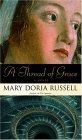
It doesn't happen often that I really fall in love with a novel. It's even rarer that I fall in love with a book on tape when the recording is flawed. In the case of Mary Doria Russell's A Thread of Grace, I am so intrigued by the story and the characters that I overcame my real dislike of the reader (more about this below) and now I can't stop thinking about the book. I'm only a third of the way through it, and it's following me around like a puppy.

is an easy sell for me, that must be clear to anybody who reads this weblog regularly or who knows my novels. Well written, carefully researched historical fiction with good, solid characters -- impossible to resist. This is one of those novels. It's not an easy read (or listen); Russell doesn't coddle her readers, and you've got to be prepared to pay attention. There are a lot of characters, and there are multiple plot lines. The opening vignette is staggering in its simple power and the way it sets up what is to come. I'm so nervous for these characters -- Jews in Italy after Mussolini handed off to Hitler -- that I sometimes get an adrenaline rush thinking about them. Because (here's the big announcement) as this is an audiobook, I can't jump ahead and read the resolutions. And it's really painful, the waiting.

Apparently Doria tossed a coin to resolve the fate of some of the characters, an idea which I find absolutely terrifying, and terribly gutsy. I couldn't do that with my characters. Impossible. Right now one of them is missing (my characters, that is). There's a penny sitting on the desk in front of me. Should I let a toss of that coin decide his fate?

Can't do it. I have no idea what this says about me, or about Doria, or about anything at all, except this: it's a rare book that puts me into this state. I keep finding excuses to go run errands so I can listen some more. Normally I do just the opposite. I'm fighting with the urge to go buy a hard copy.

One of the rationalizations for buying that hard copy would be this: I dislike the reader's approach. She decided that whenever a character would logically be speaking language x, she would read that character's dialogue (but not the internal monologue or narrative) in English with the accent of that language. As we are dealing here with characters from Belgium, France, Germany, the Ukraine, Austria, a whole range of Italian dialects, I find this very distracting. A grandmother who is a native speaker of Ukrainian speaking German -- try reading dialogue in that accent. I'm not saying the reader is bad at languages, just the opposite. She reads the occasional Italian or German or French phrase very well -- just that this was a strategic decision that really doesn't pay off, in my opinion. However, I'm so in love with the story that I'm almost able to ignore the accents.

My question (and one reason I'm so tempted about the hard copy) is whether or not Doria wrote the dialogue that way. Which I sincerely hope she did not, for reasons I've gone into elsewhere and have now reposted (below), in the hope that y'all might have some thoughts on the matter.

listening toPink Cadillac from the album "Tracks" by Bruce Springsteen

writing dialect

dialogueRather than get into a long essay on erroneous use of terms for language (the temptation is great, but I will resist), I will simply state an observation: it's never a good idea to try to convey variation in spoken language in terms of spelling. The best (and maybe the only) way to make this clear is by example. Take a look at this exchange from Gone with the Wind. In this scene, there is an elderly black man named Peter, a slave, and he's upset with Scarlett.

"Dey talked in front of me lak Ah wuz a mule an' couldn' unnerstan' dem—lak Ah wuz a Affikun an' din' know whut dey wuz talkin' 'bout," said Peter, giving a tremendous sniff. "An' dey call me a nigger an' Ah ain' never been call a nigger by no w'ite folks, an' dey call me a ole pet an' say dat niggers ain' ter be trus'ed! Me not ter be trus'ed! Why, w'en de ole Cunnel wuz dyin he say ter me, 'You, Peter! You look affer mah chillun. Te'k keer of young Miss Pittypat,' he say, ' 'cause she ain' got no mo' sense dan a hoppergrass.' An' Ah done tek keer of her good all dese yars."


"Nobody but the Angel Gabriel could have done better," said Scarlett soothingly. "We just couldn't have lived without you."

You'll note that the author attempts to portray Peter's speech by playing with spelling. The idea being, I suppose, that he doesn't speak English as it is written (something nobody does, by the way, unless you happen to be having a conversation with the ghost of somebody who lived in the 15th century). The author feels it is important to make the distinction between Peter's speech and Scarlett's.... why? Because he's a slave, and she's a free white woman of means? Because he is uneducated and she is ... a little more educated? Let's approach this differently, by rewriting the passage:
"They talked in front of me like I was a mule and couldn't understand them -- like I was an African and didn't know what they was talking about," said Peter, giving a tremendous sniff. "And they call me a nigger and I ain't never been call a nigger by no white folks, and they call me a old pet and say that niggers ain't to be trusted! Me not to be trusted! Why, when the old Colonel was dying he say to me, 'You Peter! You look after my children. Take care of young Miss Pittypat,' he say, 'cause she ain't got no more sense than a hoppergrass.' And I done take care of her good all these years."

"Nobody but the Angel Gabriel cudda done bettah" said Scarlett soothingly. "We jus' couldn't have lived without you."
I haven't changed the dialogue one bit -- I've only changed the spelling. In Peter's case all the grammatical points of his speech are maintained, such as the invariant use of third person singular verb forms ('he say'). The distinctive lexical items remain, too (hoppergrass) and the syntax (''I ain't never been call'). If it's important to portray his speech, then this passage does it by means of lexical, grammatical and syntatic variations without resorting to spelling.

I've done to Scarlett's dialogue what the author did to Peter's -- I changed the spelling to approximate how she would have pronounced the words. The result? It's amusing and condescending -- the misspellings seem to indicate something about her intelligence, or her illiteracy.

The lesson here is simple: don't play with spelling unless you have a really good reason. Playing with spelling will almost always work as a trivialization of the character, and that's never good. If it's important to portray dialect, do that in other ways.

more dialect in dialogue

It's a delicate business, but it can be done well. Examples from published fiction that you might find of interest below. I've also included a few examples from my own work -- including a passage where I commit the very sin I've been talking about here.

A lot of the second novel in the Wilderness series takes place in lowland Scotland in 1802. The language spoken by the characters would have been Scots -- not English. I'll spare you the discourse on the difference at the moment, but while I was writing the novel I struggled with representing Scots in writing, and I did end up using spelling, to some degree. Here's an example:

Geordie nodded and cleared his throat. "On the road fra Corbelly, it was, at dusk. A whole pack o' redcoats wi' baig'nets at the ready, marchin' the crew o' the Jackdaw oop the road tae Dumfries. One o' the redcoats was carryin' Granny Stoker on his back, tied han' and fit like a calf. A mair crankit auld chuckie ye'll nivver see, swearin' and skirlin' and screechin'. It was a wonder tae behold."
This is what happens if I change all the spelling to standardized orthography:
Geordie nodded and cleared his throat. "On the road from Corbelly, it was, at dusk. A whole pack of redcoats with bayonets at the ready, marching the crew of the Jackdaw up the road to Dumfries. One of the redcoats was carrying Granny Stoker on his back, tied hand and foot like a calf. A more cranky old chuckie you'll never see, swearing and skirling and screeching. It was a wonder to behold."
All I can say in my own defense is, I tried it both ways and it just didn't read right without the spelling changes. Is the effect such that the characters are trivialized? It's a little hard to tell from this passage, which is supposed to be funny, but I hope that wasn't the case. I worked hard to avoid it. The bottom line is this: I could have ignored the dialect issue and had them all speak the same, but that just didn't work for me; it would have felt like cheating.

The last example is from Curiosity, the character who so many of my readers claim as their favorite. She is an elderly black woman, a freed slave.

"No need to get particular with names, now. Don matter anyway, cause the man who lay claim to Selah wouldn't sell her, and there ain't a law that say a slave owner got to sell a slave at any price if he he got a mind to keep her. So maybe you'll understand that we ain't got much choice, not with a child on the way."
I'd be curious what folks think of the examples below -- which I think are all well done.

Flowers from the Storm, Laura Kinsale
"Bless me, what a row that was, Miss Timms! Shev was right bosky, do you see—he was used up. Corned, pickled and salted—"
"Comatose, Miss Timms," Durham explained gravely. "In strong drink."
"Oh, yes, good Oxford word. Comatose!" The colonel seemed to find that description an uplifting one. "Perfectly senseless. And we was having to carry him home, y'see, between the two of us, and he weighs—'S blood, he must weigh fourteen stone! And who might drive by at the very moment but the one they call the resurrection jarvey—"
"Night coachman. Sells bodies to the surgeons," Durham interpreted. "For anatomy lectures."
"Right! So what should I think—and it was my idea entirely, I promise you, Miss—and the fellow took him, and—" Colonel Fane made an expressive revolution with his forefinger. "And, y'know—his clothes, we got those, and the fellow took him in a sheet to old Brooks! In Blenheim Street! Took him there, to the lecturer's door!" He leaned back his head and thumped the table. "And offered—and offered . . . him for . . . f' . . . sale!"
This passage is especially nice because of the way the Kinsale has used the idioms of the time (early 1800s) in this back-and-forth between friends. It works on a number of different levels. The next passage is from Proulx's The Shipping News:
They went into the dull gloom of the shop.
"Ah," said Yark. "I 'as a one or two to finish up, y'know," pointing to wooden skeletons and half-planked sides. "Says I might 'elp Nige Fearn wid 'is long-liner this winter. But if I gets out in the woods, you know, and finds the timber, it'll go along. Something by spring, see, by the time the ice goes. If I goes in the woods and finds the right sticks you know, spruce, var. See, you must find good uns, your stem, you wants to bring it down with a bit of a 'ollow to it, sternpost and your knee, and deadwoods a course, and breast'ook. You has to get the right ones. Your timbers, you know. There's some around 'ere steams 'em. I wouldn't set down in a steam timber boat. Weak."
You'll note that Proulx does use some spelling changes to indicate dialect here, particularly the deletion of syllable initial /h/. It's not extreme, and so it doesn't distract -- but she walks a fine line. I think it ends up working because the rhythm of the passage and the use of sentence tags and prefixes: see, var, you know.

The next example is from one of my all time favorite short stories, "My Man Bovanne," by Tone Cade Bambara . It's written in first person, and the narrator is Hazel, a black woman at philosophical odds with her grown children: she's too old-fashioned for their sensibilities. Bambara was a prominent African American writer who was intensely involved in urban culture in the '60s -- and she writes Hazel's POV in Hazel's language, Bambara's own language, full of imagery and living sound. She could write this vernacular because it was her own.

"Generation gap," spits Elo, like I suggested castor oil and fricassee possum in the milk shakes or somethin. "That's a white concept for a white phenomenon. There's no generation gap among Black people. We are a col—"
"Yeh, well never mind," says Joe Lee. "The point is Mama well, it's pride. You embarrass yourself and us too dancin like that."
"I wasn't shame." Then nobody say nuthin. Them standin there in they pretty clothes with drinks in they hands and gangin up on me, and me in the third-degree chair and nary a olive to my name. Felt just like the police got hold to me.
"First of all," Task say, holdin up his hand and tickin off the offenses, "the dress. Now that dress is too short, Mama, and too low-cut for a woman your age. And Tamu's going to make a speech tonight to kick off the campaign and will be introducin you and expecting you to organize the council of elders—"
"Me? Didn nobody ask me nuthin. You mean Nisi? She change her name?"
"Well, Norton was supposed to tell you about it. Nisi wants to introduce you and then encourage the older folks to form a Council of the Elders to act as an advisory—"
"And you going to be standing there with your boobs out and that wig on your head and that hem up to your ass. And people'll say, 'Ain't that the homy bitch that was grindin with the blind dude?"
"Elo, be cool a minute," say Task, gettin to the next finger. "And then there's the drinkin. Mama, you know you can't drink cause next thing you know you be laughin loud and carryin on," and he grab another finger for the loudness.
"And then there's the dancin. You been tattooed on the man for four records straight and slow draggin even on the fast numbers. How you think that look for a woman your age?"
"What's my age?"
"What?"
"I'm axin you all a simple question. You keep talkin bout what's proper for a woman my age. How old am I anyhow?"
And Joe Lee slams his eyes shut and squinches up his face to figure. And Task run a hand over his ear and stare into his glass like the ice cubes goin calculate for him. And Elo just starin at the top of my head like she goin rip the wig off any minute now.
"Is your hair braided up under that thing? If so, why don't you take it off? You always did do a neat cornroll."
"Uh huh," cause I'm thinkin how she couldn't undo her hair fast enough talking bout cornroll so countrified. None of which was the subject. "How old, I say?"
"Sixtee-one or—"
"You a damn lie Joe Lee Peoples."
"And that's another thing," say Task on the fingers.
"You know what you all can kiss," I say, gettin up and brushin the wrinkles out my lap.
"Oh, Mama," Elo say, puttin a hand on my shoulder like she hasn't done since she left home and the hand landin light and not sure it supposed to be there. Which hurt me to my heart. Cause this was the child in our happiness fore Mr. Peoples die. And I carried that child strapped to my chest till she was nearly two. We was close is what I'm tryin to tell you.