A beautifully illustrated book is enough to turn me into a puddle of delight, and I know I am not alone in that. So why (let me ask this in a normal tone of voice) are there no museums dedicated to the great illustrators?
This topic came to mind because I just found the toymaker's journal, where I got lost for an hour and could easily spend a lot more time. Marilyn Scott Waters also has an online workshop where you can download paper toys to assemble. Or you could go get her book (The Toymaker: Paper Toys That You Can Make Yourself). I plan to.
 If I had a zillion dollars, I'd collect original art from illustrators I adore (all of these having to do with children's books, which brings me to my second question: why can't adults get illustrated books, too?):
I particularly like the brothers Robinson (Thomas Heath, Charles, William Heath) -- who don't nearly enough attention. James Hamilton wrote a book about William Heath Robinson (1872 - 1944), who is considered to be
the greatest comic draftsman of the century. His name became synonymous with outrageously complicated devices for carrying out the most basic tasks, contraptions that he thought out with solemn logic, executed with precision, and explained with the ultimate in deadpan captions.
Monty Python, anyone?
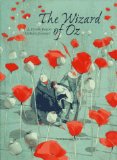
Another artist I really adore is Lisbeth Zwerger (left)
The zillion dollars is not much of an exaggeration. Have a look at storyopolis (an incredible place to browse for children's books, by the way) and the artists whose original work they represent. No matter how much I adore Lisbeth Zwerger, I can't come up with $12,500 for one of her originals. Not if we want to send the girlchild to college.
Helen Oxenbury (right) illustrated Phyllis Root's Big Momma Makes the World, which is right up there with Robert Munsch's The Paperbag Princess as a book to be presented to little girls when they start reading.
Jim LaMarche illustrated Laura Krauss Melmed's The Rainbabies, an all time favorite of mine. It's a beautiful book. I wish I had the final image as a life-size painting.
Finally there's N.C. Wyeth.
Looking at his illustrations can put me into a trance, where I can recall with all five senses what it was like to be a little girl reading in the Lincoln Avenue branch of the Chicago Public Library.
If a genie popped out of a bottle and offered me the choice between a singing voice ala one of the great divas, the ability to churn out novels like Dickens, or the imagination and skill of one of these illustrators, I wouldn't hesitate to put away paper and pen for illustration board and pencil. Of course, the best of both worlds would be to illustrate my own books.
 I get the idea that we are going to be seeing more movies that deal with the history of Africa in the last fifty years. Sometimes the only way to get people to pay attention is to wrap up the less-than-pretty truth in a story that is visually palatable.