" /> storytelling: April 10, 2005 Archives

« April 7, 2005 | Main | April 12, 2005 »

April 10, 2005

one person's trash

This quote is from W.H. Auden, who was one of the principal poets of the last century. It comes from his autobiography (it's not a standard autobiography, but there's not much else to call it), A Certain World:

For an adult reader, the possible verdicts are five: I can see this is good and I like it; I can see this is good but I don't like it; I can see this is good and, though at present I don't like it, I believe that with perseverance I shall come to like it; I can see that this is trash but I like it; I can see that this is trash and I don't like it.

This both interests and disturbs me, because while it looks very even handed and reasonable, there's one flaw I can't get past. Every book must fall into one of two primary categories: this is good or this is trash.

So I tried to figure out how this does or doesn't work for me. I've named novels that fall into each category, for me personally.

1. I can see this is good, and I like it. The Magician's Assistant; Pride & Prejudice; A Thread of Grace
2. I can see this is good, but I don't like it. almost all of James Joyce
3. I can see this is good and, though at present I don't like it, I believe that [with perseverance] I shall come to like it. Atonement
4. I can see that this is trash but I like it. I prefer the wording: guilty pleasures: Princess Daisy
5. I can see that this is trash and I don't like it. DaVinci Code
But there are so many books that don't fit into any of these five categories. Many, many books that I cannot call good, or trash. So now I'll try to come up with my own variant on Auden's list. In the meantime I'm off to Starbucks, my laptop firmly under my arm.

Carnivale (HBO), Season Two **-

This season of Carnivale started out well, and then started to fall apart about half way through. They wrote themselves into a plot corner and then constructed a very complex evil:good backstory that involves a set of Tarot like characters, some of whom bleed blue. They magically infused knowledge of the whole mess into a key character's mind in order to solve some of the plotting problems, which came across as what it was: a cheat. They descended into the silly, to be blunt. Some storylines maintained a little integrity, but they were few. And the climax, the confrontation between the two main characters (the evil/devil preacher and the healer/good carnie) -- it was pretty bad. When you stoop to confusing the viewers with convoluted backstory in order to get yourself to where you want to be at the end of the season, you've blown it.

It's sad when a good story goes bad.

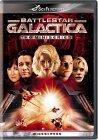
Battlestar Galactica ****(+)

I've been thinking about writing this review for many months, ever since I saw the Battlestar Galactica miniseries. Now the first season has ended, and I've come to the conclusion that while BSG can't replace Farscape, it's damn good, and deserves a lot of recognition. So just to make myself clear: five stars = Farscape. Battlestar Galactica may end up with a four++, if it continues on its current trajectory.

You probably know some version of the story, which has been around in one form or another for a long time (starting with the first television series, circa 1980). Humans create sentient machines; machines decide they can do without humans, and start cleaning house. At the beginning of this version or iteration of the story, humans exist on on twelve planets with an aging military fleet in a state of uneasy peace when the bad machines -- called Cylons -- show up again, intent on getting rid of us once and for all. So there we are, fighting a war without enough resources, dying in vast numbers. The storyline revolves around the head of the military (played with subtle, vaguely threatening intensity by Edward James Olmos), the president (Mary McDonnell), a former secretary of education, various pilots and support personnel, and the Cylons. Who can look like metallic robots or, here's the innovation -- like humans. And they've got a great spy system in place. They've infiltrated in the most imaginative ways, compromising a key character. And another nice twist: some human-looking cylons don't know they're cylons, because they haven't been activated.

The things I like best about BSG: it's gritty, and it feels real inspite of the science fiction nature of it and cgi. I love the fact that the human population has a dominant religion that is nothing like what we now cope with. People are raised believing in the gods, and the idea that they are playing out a scenario setup by the gods that repeats itself over and over, forever. Those who don't believe in the gods kind of shrug and make up their own explanations for why things are happening. But the very cool twist is this: the Cylons, the ones who look like humans and act like humans and seem to feel emotions in a human way -- they believe in the one god, the old god, and they preach, where they can, the will of that one god to non-believing humans.

This is a very small part of the overall makeup of BSG, but it's the kind of detail that makes the story interesting to me, aside from the human interactions. There's no great love story here, but that's okay for Galactica. And I'm looking forward to the new season.

As a side note: I have to say that I wish Ben Browder had found a new home on this particular Battlestar rather than with the Stargate crew, but then I'll give that every chance, once he's on board.